
Everyone who was raised in the Church of Jesus Christ of Latter-day Saints has heard of Kolob and has their own ideas about it. Almost everyone who was not raised in the church who hears about Kolob thinks it sounds very strange and mystical. Although Kolob is completely irrelevant to our salvation and the gospel of Christ, it has always been a captivating subject for the Latter-day Saints. In this post, I’ll review what we know about Kolob, and then present two different ways to make sense of it. This discussion will include a fair amount of speculation on my part, which I hope will be viewed as educated speculation, as opposed to wild speculation. None of it should be taken too seriously or considered official doctrine.
What is Kolob?
Kolob is a star described in Abraham chapter 3 and facsimile 2. It is described as the “first creation, nearest to the celestial, or the residence of God,” and “First in government, the last pertaining to the measurement of time.” We read in Abraham 3: 2-4,
“And I saw the stars, that they were very great, and that one of them was nearest unto the throne of God; and there were many great ones which were near unto it; And the Lord said unto me: These are the governing ones; and the name of the great one is Kolob, because it is near unto me, for I am the Lord thy God: I have set this one to govern all those which belong to the same order as that upon which thou standest. And the Lord said unto me, by the Urim and Thummim, that Kolob was after the manner of the Lord, according to its times and seasons in the revolutions thereof; that one revolution was a day unto the Lord, after his manner of reckoning, it being one thousand years according to the time appointed unto that whereon thou standest. This is the reckoning of the Lord’s time, according to the reckoning of Kolob.”
This scripture gives the impression that we can look up in the sky and actually see the star that is nearest to God’s home. This brings a sense of wonderment to the minds of the Latter-day Saints. Our fascination with Kolob has made it the namesake for many parks, neighborhoods, streets, and geographical features throughout Utah.
There are many theories about the identity of Kolob. They range from fully spiritual to fully physical, and from within our solar system to outside our universe. They have varying levels of connection to what the scriptures actually say. I have developed two theories about Kolob as I’ve tried to make sense of the Book of Abraham. The first theory is based on the ancient Babylonian and Egyptian astronomy that would have been more familiar to Abraham. As of right now, I personally believe that this is the correct way to look at it. The second theory is based on modern astronomy, and is probably wrong but describes a few concepts that any theory based on modern astronomy needs to consider. Both theories might be interesting to readers.
What do we know?
Let’s start with what we already know. First of all, we know that Kolob is not a made-up name or a word in some unknown heavenly language. It is the actual name of a star in the night sky as it was known by ancient people in the Middle East. The problem is that many of the stars had names that might have been pronounced like Kolob, and that’s what makes it difficult to pin down.
Ancient written languages didn’t include vowels, so sometimes a word can have a few different meanings depending on which vowels you put into it. For example, the word KRN was used in the Old Testament to describe how Moses looked after he came down from Mount Sinai. The Hebrew word KRN can either mean “horn” or something similar to “radiant,” depending on the vowels. We’ll never know exactly which word the author intended to use, but most translators have chosen the “radiant” option. However, Michelangelo’s Moses sculpture proves that at least some translations described Moses as having horns.
Many of the unusual words in the book of Abraham have been successfully identified in ancient Hebrew, Arabic, and Egyptian languages. They generally match Joseph Smith’s interpretations. Here are some examples:
- Kokob: (Hebrew) kōkāb, meaning “star.”
- Kokaubeam: (Hebrew) kōkābīm, meaning “stars.”
- Olea: (Hebrew) yārēaú, meaning “moon” or “month.”
- Shinehah: (Hebrew) šānāh, meaning “year.” (Egyptian) šnw heh, meaning something like “eternal encircling.”
- Raukeeyang: (Hebrew) rāqīa, meaning “expanse.”
Kolob may be derived from the Hebrew word KLB, meaning “dog.” It could also originate from the Arabic QLB meaning something like “core, heart, center.” Another possibility is the Arabic QRB or the Hebrew cognate qārōb, meaning “near.” Many stars had names like these in ancient times. Here is a short list of some of them:
- Antares: Qalb al-’aqrab (Heart of the Scorpion)
- Mirach: Qalb al-Ḥūt (Heart of the Fish)
- Regulus: Qalb al-Asad (Heart of the Lion)
- Sirius: Kalb (Dog)
There were probably many others. The “heart” of any constellation could have been called “qalb,” which makes it very hard to know which star is Kolob by only looking at the name. If we want to identify Kolob, we need to not only match the name, but also all these characteristics mentioned in the Book of Abraham:
- Near to the residence of God.
- The “great one” compared to other stars.
- A thousand-year revolution.
- Oliblish stands next to it and is equal in its revolution and measuring of time.
Any convincing theory has to have an explanation for all of these descriptions.
Sirius: based on ancient astronomy
If the Book of Abraham was really written by Abraham, then it is very likely that his writings have nothing to do with modern astronomy. People in Abraham’s day observed the motion of the planets and stars above the Earth. The regular periodic motion of the heavenly bodies provided the most reliable system of keeping time.
The entire cosmos appears to complete one cycle every day. The moon travels across the background of the stars about every 27 days, but its phase depends on the relative location of the sun, which is why a month is closer to 30 days. The sun travels across the background of the stars once a year. These heavenly cycles formed the foundation of calendars all over the world. Hence, Abraham says they were set by God to govern time.
But what about Kolob and the thousand-year cycle? This has to do with a particular quirk of the Egyptian calendar called the Sothic cycle. By observing the annual heliacal rising (the day when a star is first visible above the horizon before sunrise) of Sirius, or Sothis as they called it, the Egyptians realized that their 365-day solar calendar was off by one quarter of a day. Every 4 years, the time of the heliacal rising of Sirius would get pushed back one day. Eventually, after about 1,460 years, it would complete a full cycle and rise on the original date again.
Abraham and the Egyptians didn’t update their calendar. Apparently they preferred to have a year that was a whole number of days. This meant that the stars had to be moving very slowly around the Earth relative to some eternal, stationary background. With this view, after the sun completed its 365-day journey across the sky, the star Kolob had moved about one quarter of a degree. That is why Abraham interpreted it as a revolution.
This was probably the longest periodic time interval that the Egyptians were able to observe. The key point of observation of this motion was Sirius, because it was the brightest star in the night sky, and very important to the Egyptians because it was known to be the bringer of the annual Nile floods. Sirius was called KLB in ancient Mesopotamia where Abraham used to live, which is why he called it by that name. It is still known as the “dog star” to this day. Thus we have a 1,460-year “day” determined by the revolution of Kolob, which is set to govern long periods of time on this Earth.
Oliblish is likely a forgotten name of a star near Sirius. Several of the brightest stars are close to Sirius, including Betelgeuse, Canopus, Procyon, and Rigel. One possibility for Oliblish is Canopus, the second brightest star in the sky, which can be described as “the next grand governing creation near to the celestial.” Canopus sits at the same right ascension as Sirius. This means that it disappears for the same number of days during the year as Sirius. In other words, it “stands next to Kolob” and is “equal with Kolob in its revolution and in its measuring of time.”
The grand key Kae-e-vanrash probably relates to the slow turning of the firmament of stars, like a grand key turning the cosmos. The sun and moon move along the background of the stars, and thus borrow some of that motion. In other words, the angular speed of the sun in relation to the celestial sphere is the angular speed of the sun relative to the stars plus the angular speed of the stars or Hah-ko-kau-beam. Apparently Kolob was thought to be in charge of the rotation of all the stars within a range of about 30 degrees above and below the celestial equator (because of the angular range of the tilted ecliptic), which is why Abraham only included 15 other objects under this power. These 15 objects were 12 Babylonian fixed stars near the ecliptic (one for each zodiac sign) plus the Sun, the Moon, and the Earth. Other stars at lower declinations away from the ecliptic were governed in a similar fashion by Oliblish (Canopus), which sits farther south at 52 degrees from the celestial equator.
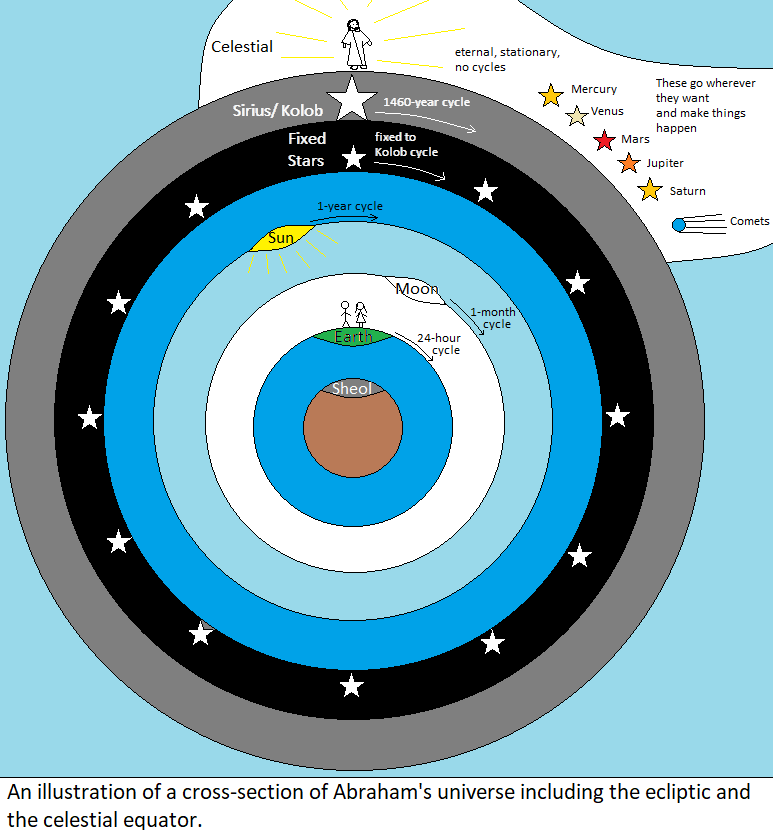
I’ve included here a schematic of the universe as Abraham knew it. It consists of concentric shells (probably cylinders) rotating within each other. The word “planet” as used by Abraham seems to refer to any one of these rotating shells. The farther up a shell or planet is, the more slowly it rotates, until you get to the Celestial Realm where God resides, which is eternal and stationary. The “fixed planets”, or stars, were considered fixed because they had no additional rotational motion relative to Kolob.
All of the astronomy in the book of Abraham makes sense when viewed from this perspective. Since Abraham was into astronomy, God apparently created an object lesson for him based on his astronomical observations. He got Abraham to think about longer and longer time periods, all the way up to the longest one he knew about. The millennial cycles of the star KLB were the closest that Abraham could get to comprehending eternity, where God dwells, where a thousand years is just another day.
Antares: based on modern astronomy
Although Abraham lived in ancient times, it can be argued that God really did show him things that the rest of the world did not yet understand. In this case, Abraham had to try to understand what God showed him based on his limited understanding of the universe. The following theory is based on the assumption that God really lives near an object called Kolob that is set to govern time in this region of the universe.
Because of relativity, we know that time is a local quantity. The present moment is not something that exists universally. The flow of time for each observer depends on their position relative to gravitational fields and on their relative velocities. Apart from relativity, the finite speed of light limits the usefulness of small time periods over large distances. If we establish a colony near Alpha Centauri, 4 lightyears from Earth, the colonists will not want to measure time in terms of Earth’s calendar. Earth’s motion will be irrelevant to them, and it will be very difficult to synchronize their clocks with ours when they can’t even see us. They will need to make their own calendar based on their local solar system.
What kind of “day” could we define for our neighborhood of stars that would actually be useful for interstellar organizations? It would have to be a time period that all the local solar systems could agree on? The colonists orbiting the other stars should be able to send us a message saying “Hey, can you remind me what interstellar day it is right now?” and receive a response from us long before the interstellar day comes to an end. For our nearest neighbors at Alpha Centauri, that back-and-forth communication would take at least 8 years. For a whole neighborhood of solar systems, an interstellar day long enough for all of them to communicate with each other in meaningful ways would probably need to be at least as long as 1,000 Earth years.
So what does this have to do with Kolob? The book of Abraham explains that God uses the revolution of Kolob, a period of 1,000 years, to govern time in our region of the universe. This would only make sense if Kolob is within a distance of 1,000 lightyears from Earth. So if Abraham’s writings are based on true astronomy, Kolob must be relatively close to us, and serves as the keeper of the interstellar days in our local time-zone of the galaxy.
Any galactic calendar with days as small as this would have to define local days differently in every region of the galaxy, somewhat similar to how we define time-zones in different places on Earth. The local day would need to be based on some stable periodic motion that is easily visible by all the planets in the region. It makes sense then, that Kolob would be a big, bright star, so that anyone in this region of space could look at it to keep track of the local interstellar day.
What kind of object must Kolob be to have a rotation or revolution of 1,000 years. That is far too long for a stellar rotation, and far too short for a revolution around the whole galaxy, but it is right in the ballpark for a stellar binary (two stars orbiting each other). This seems to be indicated by Abraham’s description of Oliblish in Facsimile 2. Oliblish stands next to Kolob and is equal with Kolob in its revolution and measurement of time. It would be extremely improbable for two separate stars to have the same revolution time by chance, so we must assume that they are orbiting each other. Kolob’s binary partner probably would not have been visible with the naked eye, but Abraham may have mistakenly identified it with another nearby star. This narrows down the list of possible Kolobs to the binary star systems with orbital periods of approximately 1,000 years within 1,000 lightyears from Earth.
After skimming through the star catalogs, I found several binary stars with orbital periods in the right range. Some of the most promising were 41G Arae, Psi serpentis, and HR4458, which are all within 50 lightyears. However, there was one that really stood out. At about 550 lightyears from Earth, Antares still burns bright enough to be one of the 15 brightest stars in our night sky. Antares is a red supergiant, with at least 12 times the mass of our sun, 680 times the diameter, and 10,000 times the brightness (100,000 times if you include the infrared spectrum). Antares has a binary partner about 7 times as massive as the sun. Their orbital period has been estimated to be in the range of about 800 to 2600 years. Antares is the largest member of the Scorpius-Centaurus association, which consists of at least 436 stars.
Look for Antares in the constellation Scorpio. When you find it, you will notice that, from Earth’s point of view, Antares is near the galactic center. This may be what is meant by God’s residence being near Kolob. Of all the visible stars in the “Kolob time-zone,” or belonging to the same order as our planet Earth, Kolob (Antares) is the closest to the galactic headquarters which lies near the center of the galaxy. That makes it easy to remember where to look for our local timekeeper star.
What about the name? One of the possible origins of the word Kolob is the Arabic “qalb,” which was one of the names of the star Antares. Abraham said Kolob signified the first creation, nearest to the celestial. God said “the name of the great one is Kolob, because it is near unto me.” This seems closer to the meaning of QLB which means heart, or center, than to KLB, which means dog.
Conclusion
There are a lot of Kolob theories out there, but these ones make the most sense to me. To be honest, I prefer the Sirius theory, but I’ll let you decide for yourself which one you prefer. In any case, it doesn’t really matter, so don’t take it too Sirius-ly!



 Truth Reconciled
One response to “Kolob Demystified”
I really enjoyed your article! There’s a reason for that stuff to have been given to us. It wasn’t meant to be ignored.
LikeLiked by 1 person