
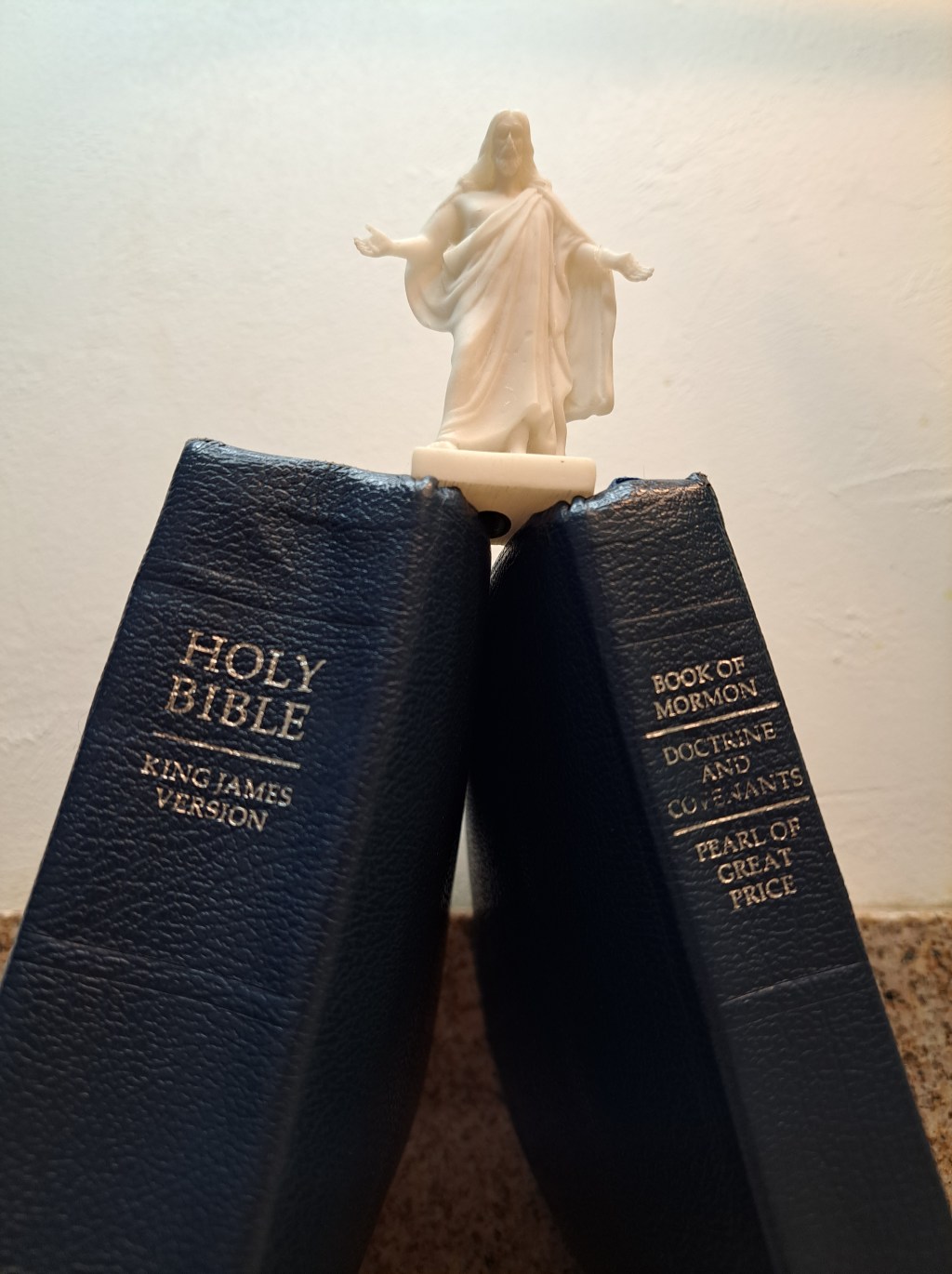
As I stated in the previous article, there is no way to derive the existence of the God we know from pure abstract logic, and therefore any argument in favor of his existence must rely on evidence gathered from the world we live in. The best evidence consists of recorded interactions between people and deity that are difficult to explain in any other way, often called miracles.
In the sections that follow, I present some of the known evidence for God’s existence, in order from weakest to strongest. It can be divided into three categories which I refer to as the common evidence, the Christian evidence, and the Latter-day evidence.
The Common Evidence: The Testimony of Billions
Since the beginning of history, people everywhere have claimed to experience the influence of a higher power. The beliefs about this higher power have taken many different forms, and some creeds have developed and been refined more than others, but the idea that there is some type of divine consciousness that observes and interferes in mankind’s affairs is common throughout the entire world.
The most compelling testimonies are from those few who claimed to have seen or spoken with divine beings. Many of their experiences are recorded in the Bible and other books. Some notable examples include Abraham, Isaac, Jacob, Moses, Joshua, Elijah, Elisha, Amos, Isaiah, Micah, Jeremiah, Ezekiel, Daniel, and many others. Usually these people suffered much persecution for the marvels they claimed to have witnessed. The fact that they continued to testify and never denied their experiences, even in the face of death, is strong evidence that they were not lying. From the list I presented, Isaiah, Jeremiah, Ezekiel, Micah, and Amos were killed because of the things they claimed to have witnessed. Abraham, Elijah, and Daniel would have died as well if they had not escaped or survived their martyrdoms. It can be said that they sealed their testimonies with their blood.
These men and many other martyrs believed beyond any doubt that God was real and truly had spoken to them. To doubt his existence requires one to discount the testimony of all these martyrs, and the testimonies of billions of common believers. You would have to believe that you are wiser than all of them. Somehow you have managed, against all odds, to see the truth that no one else can see.
This is understandable, given that there are thousands of religions in the world that all teach conflicting doctrines. It is obvious that people everywhere believe things that are false, and it can be hard to take their testimonies seriously. I once met a man who sincerely believed that snakes used to fly like birds until the Virgin Mary cursed them a few years ago. He knew it was true because his grandfather told him the story and claimed to have seen the flying snakes. This probably originated from true stories of snakes jumping out of the trees in the region where he lived, but the truth was twisted in this man’s mind. Any attempt to reason with him was doomed from the start, as he was unwilling to consider anything that contradicted his firmly-held beliefs.
This is a case where David Hume’s criticism applies. The sanity and good sense of some people cannot be confirmed. But still, most of the people I’ve met in my life believe in a God-like being, and many claim to have communicated with him, and witnessed miracles. I consider most of them to be sane, intelligent, and honest people. The insane are the exception, not the norm. We shouldn’t allow the testimony of one insane person to discredit the testimonies of a billion intelligent and sane people. Also, despite that particular man’s stubbornness, I’m sure that he would not have been willing to become a martyr for the flying snakes.
In our modern world, where many people are highly educated and reasonable, most are still religious. Many of them have advanced degrees in every area of science, engineering, technology, mathematics, and philosophy. How can any honest, educated person have the audacity to simply reject all their testimonies and claim that they themselves know better than all of them? It is okay to have some doubts, but to completely discount the sanity and intelligence of all these people is nothing short of arrogant.
If you have doubts about God, then those doubts should lead to further investigation, not willful ignorance, otherwise you are no better than the science-denying religious fanatics who hold firmly to the incorrect beliefs of their parents without ever questioning them. Truth seekers ask questions. If you ask any intelligent, religious person if they ever doubted their faith, they will probably answer in the affirmative, and yet they remain religious because they either confirmed their beliefs through investigation or found insufficient evidence to reject them.
In summary, there are billions of witnesses to deity. A large portion are from modern times. Most of them are intelligent, sane, and good people. Millions of them are highly educated. Many of their testimonies are very compelling. Millions of them would be willing to bet their life on God’s existence, and many in the past already gave their lives for this belief. Will you simply reject all of their testimonies? Why would you do that? How can you justify it?
The Christian Evidence: God Lived Among Us
The second major branch of evidence comes from an extraordinary man who lived two thousand years ago. According to what is written, he was probably the kindest man who ever lived, and yet he was extremely hated by many in his day and in our day. The value of this evidence lies not only in its miraculousness, but also in its description of the nature of God. In other words, it not only serves as evidence of God’s existence, it shows us what he is like.
Jesus of Nazareth was born in humble circumstances but managed to become, arguably, the most famous person in history. The miracles he performed were unmatched by any who ever lived before or since. They could not be explained without assuming the influence of deity. Multitudes of believers followed him. According to the eye-witness accounts, he healed their sick, gave sight to the blind, restored hearing to the deaf, and cured physical and psychological ailments that are still incurable by today’s standards. It is written that he calmed the storms, walked on water, and miraculously provided food for thousands. He taught with power and authority unlike anyone else in his day. He claimed that he was the Son of God, the Great “I AM” who spoke to Abraham and the other prophets, and the promised Messiah. He fulfilled all the ancient messianic prophecies, including his death and subsequent resurrection. These miracles were witnessed by many, and the news spread rapidly.
Jesus instilled such faith and hope in his followers, even after his death, that they continued to carry on his work even in the face of immense persecution. Many of these saints lost their lives because they would not deny what they knew to be true, that Jesus was the Messiah, the Son of God, who was sent by his Father to save all of us from sin and death, so that we might enjoy an eternal happy existence with him, because he loves us. These people saw Jesus with their own eyes and touched him with their own hands after he had risen from the dead. They watched him as he ascended into heaven at the end of his earthly ministry. They could not deny what they had witnessed and felt compelled to share it with all the world, no matter the cost.
Despite the magnificence of Jesus’ life, there are many who willfully ignore it and pretend it didn’t happen. They claim it was all fabricated for some reason. If so, it is an extremely impressive fabricated history which agrees entirely with secular history. It was so believable that it inspired thousands of early saints to give their lives for the cause until it spread to millions throughout the world and over time came to dominate world cultures. If the life of Jesus did not occur as written, then why did so many people put so much faith in him in those days? Why did they continue to have faith after he died? Why did they claim he resurrected if deep down they really thought he didn’t? They wouldn’t sacrifice their livelihoods and their very lives for a hoax. They really believed it.
Some claim the ancient messianic prophecies did not exist until after Jesus’ time. If that was the case then why are those scriptures accepted by the Jews? Shouldn’t they have sought out and burned all of those new fake scriptures that the Christians were using to claim that the man they killed was the promised Jewish Messiah? Instead the Jews, just like the Christians, acknowledge that those scriptures are of ancient origin. The Jews were familiar with the prophecies in the days of Jesus, and that is another reason why so many believed in him. In the writings of Christ’s apostles, they quote the old prophecies frequently because everyone knew and respected the writings of the ancient prophets.
Many men and women bore their testimonies of the Living Christ and his divine mission and refused to deny it even when threatened with death. The first was John the Baptist, the man who baptized Jesus and witnessed the Father and the Holy Ghost bear testimony that he was the Son of God. John was beheaded by Herod. The next martyr was Jesus himself. He allowed himself to be unjustly arrested, tortured, and crucified. He truly believed in his mission.
Eventually, almost all of the apostles and many of Christ’s other disciples met with similar fates because they would not deny the truth. Stephen was stoned to death after claiming that he saw Jesus on the right hand of God. James was beheaded in Jerusalem by Herod. Andrew was crucified in Patras around 60 AD. Peter and Paul were both executed in Rome by Nero, Peter by crucifixion and Paul by beheading. Thomas was pierced with a lance in India around 72 AD. Phillip was probably martyred around 80 AD. Tradition holds that all the apostles except for John and the traitor Judas Iscariot died as martyrs. They sealed the truth of their testimonies with their blood.
All the pieces of evidence I’ve presented in this article demonstrate the influence of God in our world. For some people, none of this evidence is necessary, and for others, all of it might still be insufficient. Personally, I like to have as much evidence as possible. I feel uncomfortable putting faith in things that are uncertain.
Christianity is the religious branch with the most significant recorded evidence that God actually physically came to Earth and lived among us mortals for a time. The effects of that visit were so profound that it has been a major factor in shaping the modern world. Jesus is often considered the most influential man of all time. The reason for this is that he was not just a man; he was the Son of God, as he said. His visit gives powerful evidence that God really does exist and cares deeply about all of us, and that he has a plan for us. It is hard to deny the testimonies of all of those early saints who paid the ultimate price to prove the truth of their words.
The testimonies of Jesus did not end with the deaths of the apostles. Many good and faithful people were inspired through the Holy Spirit or had visions and revelations throughout the ages that testified of the divinity of Jesus Christ. It continues in the present day.
The Latter-day Evidence: The Book of Mormon
The third major branch of evidence, and to me the most compelling and powerful, is what I call the Latter-day evidence. It includes the indisputable existence of the Book of Mormon and all the miracles that occurred in modern times to bring it forth. When one considers all the evidence, it is impossible to come up with a believable non-miraculous explanation for it.
Here’s the short version. In 1820, the 14-year-old Joseph Smith Jr. sincerely wanted to know which of the Christian churches in his community was right. He went into the woods to pray and experienced one of the most magnificent visions of all time, a personal visit from Jesus Christ and God the Father. In the vision, he was told that the fullness of the gospel of Christ had been lost but would soon be restored. At age 17 he received another heavenly visit, this time from an angel named Moroni who had been sent to tell him about a set of gold plates buried not far from his home, which contained a history of an ancient American civilization and the fullness of the gospel of Jesus Christ. Moroni showed Joseph where it was buried, but he was not allowed to take it until four years later. Joseph then translated the book with help from God and published it as The Book of Mormon.
Many deceivers have invented miraculous experiences throughout history, but what makes Joseph Smith’s story so unique is that the more you learn about it, the harder it is to doubt. The history is extremely well documented (see josephsmithpapers.org) and there were many witnesses. Joseph Smith showed the gold plates to at least eight people, and their signed testimony is printed at the beginning of every copy of the Book of Mormon. Three other witnesses, Oliver Cowdery, David Whitmer, and Martin Harris, were shown the plates in a more miraculous way, which included a visit from an angel. Their signed testimony is also printed at the beginning of the Book of Mormon.
One might think that these men were just co-conspirators with Joseph Smith, looking to gain fame and fortune together through an elaborate hoax. But as I said, the more you learn about it, the harder it is to doubt. All three of these men eventually left the church and turned against Joseph Smith and said terrible things about him, but none of them ever denied their testimony of the Book of Mormon and the vision that accompanied it, even when pressured to do so. Why wouldn’t they deny it? If they no longer believed Joseph was a prophet and they wanted to stop him, why didn’t they do the one thing that would have done the most damage to his endeavors? It can only be because they really believed in the divinity of the Book of Mormon, despite their qualms with Joseph, and they feared the judgment of God if they denied it.
The significance of the Book of Mormon is that it is a second witness of Jesus Christ. The Bible contains the history of Christ’s visit to the land of Israel, and the Book of Mormon tells of a visit he made to the people of ancient America after his resurrection. In both places, prophets preached and prophesied of him for centuries before his arrival. In both cases, he was the same man, and taught the same gospel. In this way, the Book of Mormon serves as an independent witness that proves that the stories of the Bible are true. The scriptural evidence is much stronger now that it comes from two independent nations rather than just one. The Book of Mormon also completes the picture of God and elucidates his Gospel. Certain passages (or omissions) from the Bible that were confusing and caused division are explained clearly in the Book of Mormon.
Over time, more and more evidence has come to light in favor of the Book of Mormon. At the time Joseph Smith published the book, there was little in common between the cultures described in the Book of Mormon and the 19th-century understanding of the Ancient Americans. However, in the field of archaeology, time has definitely favored Joseph Smith over the so-called “experts” of his day. Some of the new evidence includes the discovery of cement in Ancient American structures, the land of Nahom (which was mentioned in the Book of Mormon but was unknown in Joseph’s day), large ancient cities and highways running all over the jungles of Central America, the discovery of many inscribed metal plates in the Middle East, the seal of Mulek found in Jerusalem, and the discovery of Ancient American barley. All these discoveries have validated the history recorded in the Book of Mormon.
The Book of Mormon claims that it was written in “Reformed Egyptian,” and conveniently a few of the characters on the plates were copied and are available today for anyone to see. One of the three witnesses, Martin Harris, took some of these characters to a man named Charles Anthon so that he could give confirmation that they were indeed ancient characters. He gave his approval, but revoked it after hearing the story of how the book was discovered. He asked Martin to bring it to him so he could translate it himself. Martin told him that a part of the book was sealed, to which he responded “I cannot read a sealed book,” and thereby fulfilled a prophecy in Isaiah 29. The characters are now known to be Egyptian demotic, which is a shorthand version of Egyptian hieratic. In the timeframe of the Book of Mormon, around 600 BC, it was common for Jews to write Hebrew documents with these Egyptian demotic characters. This was not known in Joseph Smith’s time, but once again archaeology has favored the truth.
Besides the external evidence, the book itself serves as strong evidence that it wasn’t fabricated. The Book of Mormon is full of deep and well-articulated doctrinal passages, complex interconnected storylines, bold prophecies, and inspiring counsel. It is inconceivable that Joseph Smith, a farm boy with three months of education, could write such an impressive document in such a short time and at such a young age (he was 24 at the time of its publication), especially given the fact that people who knew him stated that he “…could neither write nor dictate a coherent and well-worded letter, letter, let alone dictat[e] a book like the Book of Mormon,” a world-changing book that withstands assaults from all angles and the tests of archaeology for hundreds of years after its publication.
Because of this, many have argued that Joseph was not the author, but some other close educated friend was. But modern stylometric analysis has concluded very firmly that the writing styles in the Book of Mormon do not match those of anyone Joseph knew, or any renowned authors of his time, or even Joseph himself. The analyses suggest with high confidence that the book was written by several other people, distinct from anyone who has been tested, exactly as the book itself claims.
These and many more pieces of evidence can be found on bookofmormoncentral.org and in Tad R. Callister’s book “A Case for the Book of Mormon.” The pile of evidence continues to grow from year to year, as is expected when something is true.
Joseph Smith’s own testimony is evidence of the truthfulness of the Book of Mormon. He was persecuted for the claims he made, but he was so dedicated to his beliefs that he continued to preach them for the rest of his life. Many of his friends and loved ones were persecuted and died because of it. Joseph himself became a religious martyr in 1844 when an angry mob murdered him and his brother in Carthage Jail in Illinois. Why would he and those who followed him suffer so much and still refuse to deny the Book of Mormon? It is because they really, truly believed it. Joseph Smith did not invent any of it. In his own words, “…I knew it, and I knew that God knew it, and I could not deny it, neither dared I do it; at least I knew that by so doing I would offend God, and come under condemnation.”
Conclusion
All the pieces of evidence I’ve presented in this article demonstrate the influence of God in our world. For some people, none of this evidence is necessary, and for others, all of it is still insufficient. Personally, I tend to have a hard time putting faith in things that are uncertain, and that’s why I ended up gathering all of this information. Despite the enormous amount of evidence, I know that it still doesn’t constitute proof at the level that mathematicians are used to. I do, however, believe that the evidence at this point is at the typical level of scientific observations. But even so, some will still not be convinced. I will continue this discussion in part 3.

 Truth Reconciled