
In The Foundation of Morality, I described the fundamental concepts that form the basis of my understanding of morality. The principles that I uncovered are not limited to humans only, but to almost any kind of being that we can imagine. From the beginning of existence to the present day, these principles have been playing their role in generating the rules that lead to progress.
All of existence seems to be following a pattern of refinement through natural selection that leads to higher and more complex states of existence. These higher states arise when lower entities cooperate in large numbers, in accordance with laws that emerge from their interactions. The rules that the lower entities follow can be thought of as a kind of morality. The entities that follow the moral laws manage to build the higher state. The higher state then obtains its own characteristics and develops its own laws for survival and proliferation.
From Existence to Particles
This process is apparent from the very foundations of existence, as described in my previous article The Origin of Physical Existence. After existence is established, the very first refining rule is that entities must be random, or in other words, free. When considering all the possible entities that could exist, all those that lack the vital attribute of freedom destroy each other through interference, and thus existence is refined into a free or random universe. Only a universe that is free to choose is capable of becoming anything more than a formless void.
Freedom is necessary for morality, because without freedom there are no choices. Morality is the way of judging the choices of free agents. Without freedom, there are no free agents, and morality cannot even be defined.
Once freedom is established, only those entities that follow specific laws tend to survive, while all others destroy themselves or each other through interference. Virtual particles are short-lived particles that don’t fit nicely into the Standard Model catalog of particles. Their existence is transient if it covers any time at all, but the effects of their presence are noticeable in the interactions of the “good” particles which do obey the rules. The virtual particles all destroy each other constantly through interference. The only ones that manage to prolong their existence are those that take the form of the fundamental particles in the Standard Model of Particle Physics, and perhaps others of which we are unaware. These stable particles then form cooperative networks which open the door to endless possibilities. The Standard Model particles are just a network of particles with properties that make them particularly good at preserving themselves and working together, but they are not the only particles in the universe. They have been refined to obey their own set of “moral” laws which we know as the laws of physics.
From Particles to Cells
Eventually, the fundamental particles managed to work together to form higher states of existence called atoms and molecules. These atoms and molecules roamed throughout the Earth, obeying their own moral laws which we know as chemistry. Interactions between all of the different kinds of atoms and molecules led to the formation of even more diverse sets of molecules, many of which became linked together in complex chemical networks. The networks that performed well continued to exist and grew in number, and those that didn’t, failed to increase.
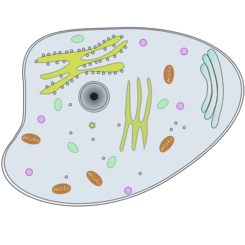
Eventually, the first living cells were created, and over time they progressed and refined themselves into what they are today. It is estimated that one human cell is made up of about 100 trillion atoms, all working together harmoniously in their diverse specialties. All of them are united in their purpose, to grow and maintain the cell, their perfect unified society, by obeying the laws of chemistry and the instructions encoded in the DNA molecule which governs the entire cell from the nucleus.
The cell, now in a higher state of being, achieved new attributes and abilities that could scarcely be imagined by an atom (if an atom were capable of imagining). Individual atoms and molecules became imperceptible to the cell, and the cell now interacts principally with other cells and extremely large—relatively speaking—amounts of inorganic matter. The cells follow their own higher set of “moral” laws, which are the study of microbiology. Those that don’t follow the laws eliminate themselves.
From Cells to Animals
Some cells, like the atoms that made them up, eventually discovered that they could benefit by working together and forming networks called colonies. Over millions of years, these colonies progressed and refined themselves into what we know as multicellular organisms, a classification that includes us humans. A higher state of being was reached yet again. We humans experience the world in ways unimaginable to cells. Cells may have the ability to move through space and manipulate matter in small amounts, but these abilities are nothing compared to the incredible power of humans and animals.
Ironically, it is estimated that the number of cells in a human body is on the order of 100 trillion, or about the same as the number of atoms in a human cell. All of these cells work together seamlessly for the same purpose: to grow and maintain the organism, their perfect unified society, by obeying the laws of microbiology and the signals which come from the brain or central nervous system. The animals and humans that these cells make up also obey laws that must be followed in order to continue existing and propagating themselves, and these are the study of biology and morality.
The Future
The evolution and refinement of existence, whether it happens spontaneously or by divine guidance, follows a pattern. Over time, the highest, most complex state of existence joins together by the trillions to create a new, higher state of being. Could there be other states, higher than those that I have presented here? If the pattern continues, then the next state of being must have something to do with interactions between large numbers of humans, perhaps within our ability to comprehend, or perhaps not.
Let’s try to imagine this next, higher state. Imagine 100 trillion highly advanced humans working together in all their specialties for the same purpose, to forever preserve and expand this great organization, the perfectly moral and unified society. You could call it “Zion.” All these people receive and obey instructions from the head, whatever it may be. They have a strict code or set of laws, learned from experience, which governs all their interactions, including the mandates from the head. Such a being would have attributes and abilities beyond what we can currently comprehend. This is the sort of being that may have the power to create worlds and manipulate nature in ways unimaginable to us now. The head of such a being would perhaps be worthy of the title of “God.” The laws which define this being, by governing all the interactions of its constituent beings, are the laws of morality.
A Pattern of Moral Refinement

About
This page is dedicated to finding answers to the deepest questions. You can expect to find essays about existence, morality, physics, religion, etc. The goal is always to discover the truth, if possible.
Recent Posts
Categories
Biology
Existence
Morality
Physics
Politics
Religious
Truth
BOOKS
Existence Solved: The Origin of the Universe and the Laws of Physics
 Truth Reconciled