
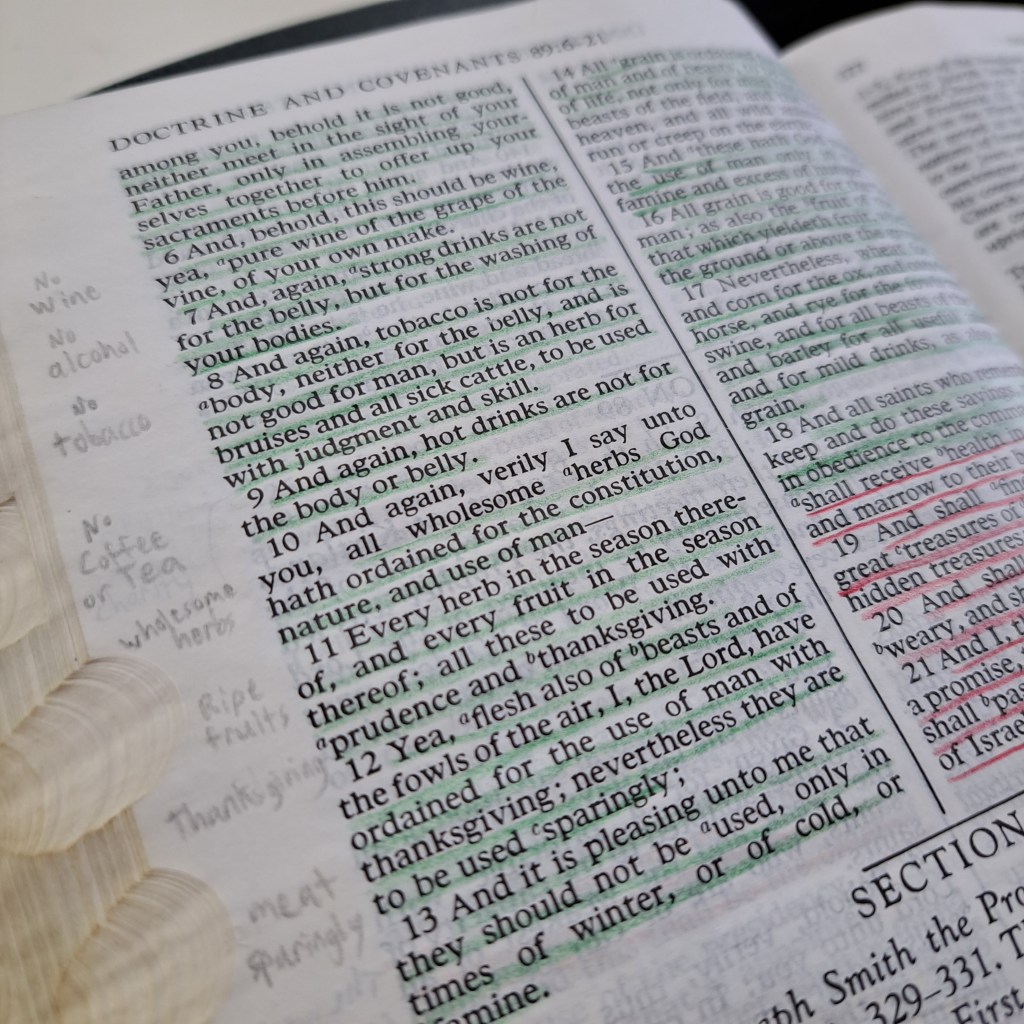
This post is only relevant to members of the Church of Jesus Christ of Latter-day Saints. It deals with what I have often considered the most confusing commandment that God has given us. I’m referring to the “Word of Wisdom,” which teaches us what substances we should and should not consume. This is the origin of our unusual habit of avoiding alcohol, tobacco, coffee, and tea, among other things. I do not doubt that this commandment was given by revelation from God. However, members of the church, myself included, have always had a hard time understanding it.
The goal of this post is to make sense of the Word of Wisdom. I will explain how I personally understand the Word of Wisdom, and the logic I use to come to my conclusions. If you just want the conclusions, then feel free to skip to the end. What I say here should not be construed as official doctrine of the church.
Widespread Confusion
One cannot help but notice the church-wide confusion about the Word of Wisdom. Its purpose, intent, importance, and what it actually entails are all up for debate. For example, here is a small sample of questions that come up again and again:
- “Is this kind of tea compliant with the Word of Wisdom?”
- “Is decaffeinated coffee okay?”
- “How much meat is too much?”
- “Is caffeine compliant or not?”
- “At what point does the alcohol content in my food become against the Word of Wisdom?”
- “Are highly-processed foods okay?”
- “Why do we often not receive the promised blessings of health when we obey?”
These questions may seem unimportant to some, but if the Word of Wisdom is of such little importance, then why are we asked about it in our baptism and temple recommend interviews? This seemingly unimportant law is one of the greatest inhibitors of spiritual progress for investigators and less-active members. Why should coffee disqualify someone from baptism and temple blessings? Eating too much meat has never kept anyone from entering the temple, and this aspect of the law is not even mentioned in the missionary materials. It’s very confusing and inconsistent.
I know God desires that we should be united, and that we should “all speak the same thing” and that we should “be perfectly joined together in the same mind and in the same judgment.” Yet this law, the Word of Wisdom, is a source of division. Some members drink green tea while others do not, some members drink decaffeinated coffee while others do not, some members eat meat every day while others eat little or none, some members drink caffeine while others avoid it, some members eat beer sausages and other alcohol-soaked foods while others do not, and we all criticize each other’s interpretations of the law. These disagreements exist not just among lay members; they rise all the way up to the general authorities. This leads me to believe that, as a church, we do not understand this law.
The Principle
The Word of Wisdom is usually presented as a commandment to avoid alcohol, tobacco, coffee, tea, and certain addictive drugs. Occasionally, someone will bring up the fact that it also tells us to eat healthy food and limit meat consumption. It was my understanding that the list of substances to avoid was not all-inclusive, and that we should focus instead on the principle behind the law. So what is the principle? I believe the principle is that we should try to consume things that are healthy, and avoid substances that are unhealthy or habit-forming.
The tricky part of this principle is that we do not know with certainty what is healthy and what is not. For example, most nutritionists agree that coffee and tea are okay to drink in reasonable amounts, and a little wine now and then is healthy, but God has told us to avoid those things completely. How do we reconcile God’s word with the research?
I see two possible paths to reconciliation:
- The research is wrong. If we trust God’s word more than current consensus, then the only way to really know what is healthy is through revelation. In other words, we have to rely on what is written in the Word of Wisdom.
- The research is correct, which means the Word of Wisdom doesn’t really teach us about the general health benefits or harmfulness of the substances it mentions.
If possibility #1 is true, then this eliminates the practicality of focusing on the principle, and instead requires us to focus on the list of substances specifically mentioned in the Word of Wisdom. In this scenario, it is impossible to resolve any questions about the Word of Wisdom unless they are given an official answer by the First Presidency of the Church.
Much has changed since the law was given in 1833. I imagine it was well-understood in the early days of the church when the only “strong drinks” were a few types of alcoholic drinks, and the only “hot drinks” were tea and coffee. But in our day, the variety of food and beverage products is seemingly endless. Are there more substances which should be added to the list of things to avoid? Can some be removed? The dearth of continued revelation on this topic leads me to believe that possibility #1 is not the correct route. Why would God leave us in the dark?
The only other scenario is possibility #2. In this case, we run into another issue. If the principle of the Word of Wisdom is to consume healthy substances and avoid unhealthy ones, then how do we reconcile this with the fact that some of the substances we are counseled to avoid are considered healthy?
Once again, I see two possibilities, which I will call 2A and 2B:
2a: We got the principle wrong; it has nothing to do with health. I won’t take this option any further, because every official statement and conference talk says the opposite.
2b: The principle is correct. This option, combined with the fact that certain of the prohibited substances are not, in general, unhealthy, requires us to interpret the counsel as specific to circumstances in the last days.
The evidence forces us to go with option 2b. The commandment is related to health, but is only applicable to the latter days. The revelation itself says the following in regards to why it was given:
“In consequence of evils and designs which do and will exist in the hearts of conspiring men in the last days, I have warned you, and forewarn you, by giving unto you this word of wisdom by revelation.” (Doctrine and Covenants 89:4)
The Word of Wisdom is a commandment unique to the last dispensation, which means it is a commandment based on modern-day circumstances. God never commanded his people in the past to completely avoid alcoholic drinks, except in a few specific cases (e.g. the Nazarenes). Even Jesus, who was perfect in every way, drank wine from time to time. So wine itself is not the issue; it is the time period that we live in. Why is this commandment given now, and not earlier? What is it about wine in the last days that makes it different from the past? Why was homemade wine for the sacrament given a pass in the original revelation?
It seems to me that the type of substance is not the problem, but rather the manner of fabrication. Alcohol today is brewed by large multinational corporations, governed by conspiring men who will risk your health, your freedom, and your life for increased profits and preservation of their company. The same is true for coffee, tea, and tobacco. Nothing like this has ever existed on this scale until now, in the latter days. Through product engineering, social engineering, and cunning marketing schemes, these companies have the power to manipulate societies to become enslaved to their products. Only those who entirely avoid these substances are protected from the manipulation.
With this knowledge, the principle of the Word of Wisdom could be expanded as follows: Avoid unhealthy and habit-forming substances and anything produced by conspiring men who would trade your health for money, and eat healthy food. Since the 1830s, plenty of new food and beverage companies have arisen with the same motives and tactics as the producers of alcohol, tea, coffee, and tobacco. This includes not only caffeinated beverages, but all commercial beverages, and also all highly processed foods and fast food. Would these products have been mentioned in the Word of Wisdom if they existed at the time it was given? I don’t know, and I can’t give an official answer. No church authority has ever spoken against them, which seems like an inconsistent application of the principle.
For example, energy drinks with high caffeine content are known to be habit-forming. If we apply the principle of avoiding unhealthy and habit-forming substances, we would conclude that we should not consume these products. However, the principle doesn’t give us the correct answer in this case, because all caffeinated beverages, except coffee, have always been permitted. The reason for this discrepancy is that the Word of Wisdom requirements for temple worthiness are not the same as the Word of Wisdom revelation given to the Prophet Joseph Smith in 1833.
The Revelation versus the Requirement
Here’s the breakdown of the counsels given in section 89 of the Doctrine and Covenants, along with the verses where they are mentioned and the number of words dedicated to each subject:
| Counsel | Verses | Number of words on subject |
| Grain/wheat is the staff of life and good for man and beasts | 3 verses: 14, 16, 17 | 97 |
| Avoid consuming alcohol, but you can wash with it | 3 verses: 5, 6, 7 | 72 |
| Animals can be used for food, but preferably only in extreme circumstances | 3 verses: 12, 13, 15 | 72 |
| Consume wholesome herbs (vegetables) and fruits | 3 verses: 10, 11, 16 | 63 |
| Avoid consuming tobacco | 1 verse: 8 | 35 |
| Avoid hot drinks, officially interpreted as coffee and tea | 1 verse: 9 | 11 |
Did you know the number one topic in the revelation was grain? Did you know God said just as many words about animal consumption as he did about alcohol consumption? You can dispute the exact number of words, but you can’t dispute the fact that grain and meat were major topics in the original revelation. But if the bulk of the Word of Wisdom counsels us to eat grains, fruits, and vegetables, and limit animal products (basically what’s known today as a whole foods, plant-based diet), why is this counsel largely ignored by the church? This selective enforcement begs for an explanation.
Here’s the reason. The Word of Wisdom was never a binding commandment to begin with. It was just good advice from God, “To be sent greeting; not by commandment or constraint.” It didn’t become a requirement for temple worship until 1921, when President Heber J. Grant called on all saints to completely abstain from alcohol, tobacco, coffee, and tea. The requirement wasn’t very strictly enforced at first, but after much insistence from church leadership it gradually became an important part of our culture. From the beginning, the requirement always focused on the prohibited substances, namely alcohol, tobacco, tea, and coffee. Later on, certain addictive drugs were added to the list. The dietary portion of the commandment never became a requirement for the saints.
As members of the church, we need to do a better job of making the distinction between the temple requirement and the original revelation. This will help alleviate much of the confusion and bickering. The original revelation was given for a “Principle with Promise,” as it says. But the requirement is just a selective list of substances to avoid, with no principle. At this point, most of the revelation is still only wise counsel. There has never been a temple worthiness requirement related to fruits, vegetables, grains, or animal products.
Any questions related to the temple worthiness requirement are between you and your bishop. The bishop will ask you, “Do you understand and obey the Word of Wisdom?” If you say yes, with all honesty, and your bishop judges you to be worthy, then that’s all there is to it. There’s no need to be fighting about chemical content, temperature, semantics, etc. If you are trying to do what is right, then you are entitled to receive personal revelation from God to know what you need to change in order to answer “yes” to that question and be worthy of temple blessings.
Blessings
Since there are two separate manifestations of the Word of Wisdom, it follows that there should be two sets of blessings. Let’s be clear that the blessings promised in section 89 of the Doctrine and Covenants are tied to the original revelation. The fulness of these blessings can only be claimed by those who follow the fulness of the law outlined in that section. I’ve listed the blessings in the following table, along with my personal interpretations of what they mean.
| Quoted blessing | Interpretation |
| “Health in their navel” | Gut/digestive health |
| “Marrow to their bones” | Bone health |
| “Shall find wisdom and great treasures of knowledge, even hidden treasures.” | Brain/Mental health, along with valuable and uncommon knowledge |
| “Shall run and not be weary, and shall walk and not faint.” | Cardiovascular health (lungs, heart, blood vessels) |
| “The destroying angel shall pass by them, as the children of Israel, and not slay them.” | Immune health, and protection from lifestyle-related chronic diseases. |
The second set of blessings tied to the temple worthiness requirement has not been clearly laid out. One obvious blessing is the right to enter the temple. Some portion of the health blessings promised in the original revelation should certainly be included as well, but not all of them. You shouldn’t expect to “run and not be weary,” and “walk and not faint,” if you only avoid alcohol, tobacco, coffee, tea, and addictive drugs, but don’t eat healthy food. You will certainly avoid several types of “destroying angels,” and your brain won’t be damaged by substance abuse, but there are many more blessings of health available to those who are willing to follow the Word of Wisdom to the fullest.
Some members of the church have tried to explain the apparent absence of these blessings with this verse of scripture in Doctrine and Covenants 29:34:
“…verily I say unto you that all things unto me are spiritual, and not at any time have I given unto you a law which was temporal.”
Because of this, they think that every blessing mentioned in section 89 must not be taken literally, and must have some hidden spiritual connotation.
This stands in stark contrast to what section 89 itself says, that the Word of Wisdom was given for “the temporal salvation of all saints in the last days.” Clearly, the blessings of the Word of Wisdom are meant to be understood in the context of temporal salvation. Spiritual and temporal purposes are not mutually exclusive. Good temporal health in the mind and body maximizes your agency and your ability to do the spiritual work that God wants you to do.
Conclusion
The Word of Wisdom is known as the Lord’s law of health for his saints. It was given as a “principle with a promise,” where the principle is to eat healthy food and avoid unhealthy and habit-forming substances. But the main reason the revelation was given was to protect us from the evil designs of conspiring men in the last days. If you think about whose evil plans are thwarted when you avoid addictive and unhealthy consumer products and only eat healthy food, it becomes obvious who those conspiring men are.
The Word of Wisdom revelation is different from, but related to, the Word of Wisdom requirement for temple worthiness. The revelation is section 89 of the Doctrine and Covenants, which tells us what we should and should not consume in order to obtain the greatest blessings of health and wisdom in the last days. It was given as counsel, and not as a commandment. The temple worthiness requirement is a list of substances that we have been commanded to avoid in order to obtain a temple recommend, namely, alcohol, tobacco, coffee, tea, and addictive drugs.
Any part of the Word of Wisdom that has not been specifically added to the list of requirements is not a commandment. You do not need to control your diet in any way to obtain a temple recommend. The specific details of the temple worthiness requirement are to be worked out between you, your bishop, and God. You should seek personal revelation to know what you should change.
The “principle” and the “promise” are part of the original revelation, and are not tied to the temple worthiness requirement. You should not expect to receive all the blessings of the Word of Wisdom if you only do what is required to enter the temple. The fullness of the blessings of health are promised only to those who follow the fullness of the revelation.

 Truth Reconciled