

Introduction
Throughout history, the laws of physics have been repeatedly explained and unified by deeper laws. Isaac Newton unified earthly phenomena with heavenly phenomena when he discovered the laws of motion and gravitation. Maxwell unified all the phenomena of electricity, light, and magnetism when he published his well-known set of equations. The paradoxical constant c in Maxwell’s equations was one of the motivations for the development of Einstein’s Special Relativity, which unified space and time. Quantum mechanics was developed soon afterward and served as a unified theory of chemistry. Quantum Field theory later unified quantum mechanics with special relativity, and eventually developed into the Standard Model of Particle Physics. Meanwhile, the General Theory of Relativity developed as a unification of special relativity and gravity. These two theories, the Standard Model and the General Theory of Relativity, explain nearly everything that we observe in the universe. But we still must ask why the universe is described by these two theories rather than some other set of laws.
Much effort has been expended by physicists to unify the laws of physics into a “theory of everything” over the last century. Most attempts to unify the two major theories fall in the realm of quantum gravity, in which attempts are made to quantize the gravitational field. This approach may turn out to be successful, but it would still not really be a theory of everything. The question would still remain, why did the universe choose to obey this quantum gravitational theory instead of another? Even if theorists managed to explain the quantum gravitational theory with yet another deeper theory, it would be just another incremental step toward that holy grail of physics, and there would still be more work to do. As long as we can still ask the question, “Why this law instead of another?” we will not have that holy grail.
In order to truly discover the theory of everything, we have to come in through the back door, starting with the deepest questions, so that we can develop a theory that needs no explanation. We need to ask a question so deep, that when it is answered, there are no more questions to ask. The fundamental question of existence, “Why is there something rather than nothing?” seems to be the deepest question of all, and I always believed that answering it would resolve many other questions in physics. In a previous article I presented the answer to that question, without assumptions. In this article, I will derive the foundations of physics from that answer.
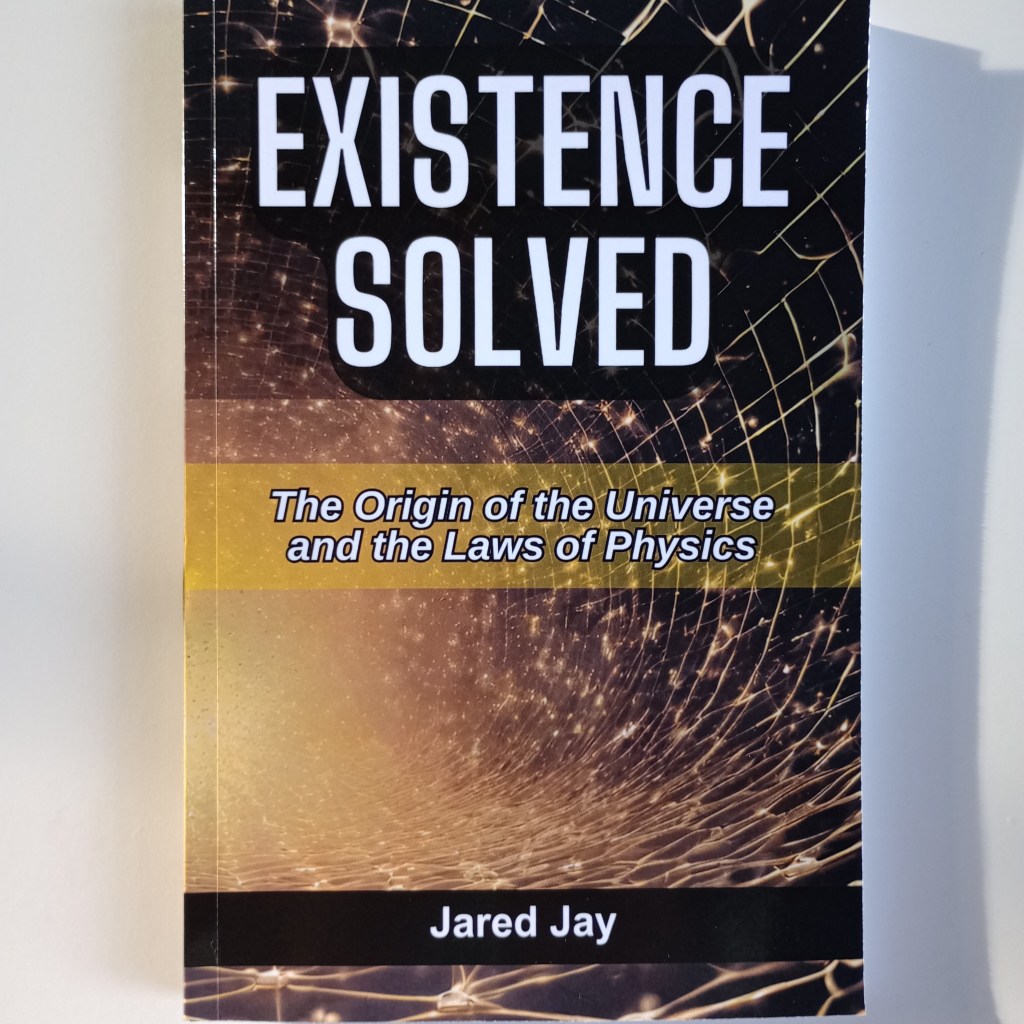
(A more thorough presentation of this theory, now known as the “Tautological Theory of Existence,” is found in the book Existence Solved: The Origin of the Universe and the Laws of Physics.)
Mathematizing Existence
In my article on The Origin of Physical Existence, we derived the quasi-existence or conditional existence of “entities,” which can change and interact with one another upon consideration of additional information. All possibilities are constantly occurring, randomly, and this iterative logical application of possibilities generates the flow of time. The entities with specific existence-preserving properties generate the more stable constituents of existence that build the matter in the universe. In this and following articles we will describe this mathematically and work out how this foundation of existence leads to the laws of physics that we are more familiar with. This article is necessarily mathematical, but there are a few points that anyone should be able to understand.
We will refer to each possible entity as a “state” of existence and denote it by 
We can define maps, or operators, denoted by 

We can define the identity operator as the operator that maps each state to itself. We can define a binary sum operator (+) signifying that both the states before and after it exist, and thus form a compound state. Mathematically,

where all three 

where 


We will represent the states in such a way that the operators follow the distributive rule,

Nothing
We can define a state 

Suppose an operator

which is only possible if 
Vectors
We can define scalar multiplication on the states such that these states satisfy properties of a vector space. We can define an inner product of states 


For any state 


Any state can be written as an operator acting on an arbitrarily chosen normalized state which we call 

and in the dual representation:

where 


Therefore, all the operators available to serve as maps between normalized states are unitary. It follows that we can write any one of these operators as 

The Universe
Now let’s consider the physical universe, which we call 

The sum 

The sum over scalar multiples is just a constant (which happens to be infinite). We can define a renormalized state 

Every normalized state 


This “alpha-omega” equation is the foundational equation of a new theory of physics. It encodes all of existence, with 


The Universal Action
“Action” is a profound principle of physics. It can be thought of classically as a quantity that describes how a physical system has changed over time. If we look at all paths that a system could take through time, we find that the one that extremizes (minimizes or maximizes) the action is the true path that the system takes. Some interpretations of quantum mechanics take this very literally, where it is assumed that a particle really does take every possible path through spacetime, but all of the timelines that fail to extremize the action interfere with one another and destroy each other. It can be shown that only the path that extremizes the action manages to survive. This is called the Path-integral Formulation of Quantum Field Theory, and it serves as a clear example from contemporary physics of the natural selection of physical laws.
The action is usually denoted by S and is often expressed as the time integral of the Lagrangian L. The Lagrangian is therefore a quantity that describes the state of a physical system at any point in time. Subdividing further, the Lagrangian density 
Therefore, the path from existential philosophy to physics is through the action
Let us now derive the relationship between 


Opposites and Randomness
Notice that if we reverse the sign of every operator

and

At this point, if our set of operators 


In the special case of a finite number of operators (or things that can happen), it is possible that some operators will not have an opposite, so we can get around this problem. This is the simpler version where we have decided to start our analysis, but we must be aware that in the full theory we need to include every possibility. However, the problem of opposites is resolved by the random sector of existence described in The Origin of Physical Existence, since some entities can randomly exist or act while their opposites randomly do not. This means that, in the end, only the random operators can have any influence on the state of the universe, because all the non-random deterministic operators are canceled out.
The Equation of Everything
Continuing our analysis, the parities (oddness and evenness) of the functions 

The real and imaginary parts (or more correctly, the Hermitian and anti-Hermitian parts) of this equation can be evaluated separately, as follows:


We now apply the series definitions of the trigonometric functions and define 


Since

where the superscripts denote the order or power of the operators

Expanding

where 


and


If we now allow N to be very large, then only terms with the highest order of N in each of the above equations will be of any significance, so that we find


Now we find that the complex sum becomes

We can divide both sides by N and note that the factor 
![\Delta[\theta]](https://s0.wp.com/latex.php?latex=%5CDelta%5B%5Ctheta%5D&bg=ffffff&fg=000&s=0&c=20201002)
![\partial[\theta]](https://s0.wp.com/latex.php?latex=%5Cpartial%5B%5Ctheta%5D&bg=ffffff&fg=000&s=0&c=20201002)

![\int e^{i\theta}\partial[\theta] = e^{i\int r_{\theta}\sin(\theta)\partial[\theta]}.](https://s0.wp.com/latex.php?latex=%5Cint+e%5E%7Bi%5Ctheta%7D%5Cpartial%5B%5Ctheta%5D+%3D+e%5E%7Bi%5Cint+r_%7B%5Ctheta%7D%5Csin%28%5Ctheta%29%5Cpartial%5B%5Ctheta%5D%7D.&bg=ffffff&fg=000&s=0&c=20201002)
which means the “alpha-omega” equation can be more properly written as
![\lvert \omega\rangle=\int e^{i\theta}\partial[\theta]\lvert \alpha\rangle = e^{i\int r_{\theta}\sin(\theta)\partial[\theta]}\lvert \alpha\rangle](https://s0.wp.com/latex.php?latex=%5Clvert+%5Comega%5Crangle%3D%5Cint+e%5E%7Bi%5Ctheta%7D%5Cpartial%5B%5Ctheta%5D%5Clvert+%5Calpha%5Crangle+%3D+e%5E%7Bi%5Cint+r_%7B%5Ctheta%7D%5Csin%28%5Ctheta%29%5Cpartial%5B%5Ctheta%5D%7D%5Clvert+%5Calpha%5Crangle&bg=ffffff&fg=000&s=0&c=20201002)
where 
![\lvert \Omega\rangle = \Big(e^{i\int r_{\theta}\sin(\theta)\partial[\theta]}\Big)^\infty\lvert \alpha\rangle.](https://s0.wp.com/latex.php?latex=%5Clvert+%5COmega%5Crangle+%3D+%5CBig%28e%5E%7Bi%5Cint+r_%7B%5Ctheta%7D%5Csin%28%5Ctheta%29%5Cpartial%5B%5Ctheta%5D%7D%5CBig%29%5E%5Cinfty%5Clvert+%5Calpha%5Crangle.&bg=ffffff&fg=000&s=0&c=20201002)
This is what I like to call the “Alpha-Omega Equation,” or the “Equation of Everything.” The beginning is
Conclusion
We started from the assumption-free philosophy of existence established in previous articles, and by representing the existing entities and their properties mathematically, we derived an equation that describes the entire physical universe. If this theory is correct, it should agree with what we already know about the laws of nature. Conceptually, this theory is in perfect agreement with the principles of quantum physics, but it is not clear at this point how it can reduce to the laws of physics we are more familiar with. Where is the Standard Model of Particle Physics? Where is General Relativity? Where is our 4-dimensional Lorentzian spacetime? We will tackle these questions in future posts.

 Truth Reconciled