

Introduction
Plenty of theory, research, and speculation has gone into understanding human personalities. There is no shortage of schemas for categorizing people. But I can’t help but wonder why this spread of personalities exists, and how it relates to our biology? What is the primary source of the variation?
The purpose of this post is to try and understand the origin of personalities, starting from some of the most fundamental characteristics of intelligence. We will then use that understanding to map out a range of personalities in a convenient and memorable way, and make connections with other popular models of personality.
But first, let me be fully honest. I am not a psychologist. My background is in physics, where the science is clear, elegant, and precise. Psychology is very messy in comparison. People are far more complex than particles and are not nearly as predictable. My speculation on the subject of personalities should not be taken as expert opinion; it is nothing more than the way that I, personally, have attempted to organize personalities in my own mind.
I approach the subject of personalities from my experience with neural networks and machine learning. I’m also approaching this differently from others in that I see people’s behavior as adaptable, flexible, and malleable. I don’t believe that anyone is stuck with one manner of behavior in all situations and for all time. You have a lowest energy default mode which defines your core personality, but you can always make an effort to act differently and, over time, change your default behavior.
Intelligence
In general, intelligence is any kind of network with the capacity to learn. In humans and animals, a network of neurons forms the main hardware of our intelligence. In the case of artificial intelligence (AI), a network of virtual nodes of computation make up the network. All intelligence has the ability to learn from experience. This is its defining characteristic.
The purpose of any given AI system depends on the intentions of the designers. In humans, however, our intelligence is given an inherent purpose by nature. The purpose of our intelligence is to interpret stimuli from our environment and generate appropriate responses that are conducive to our preservation.
The most basic function of our intelligence, besides regulating the body’s internal systems, is to determine the situation we are in, beginning with where we are in regards to our external environment. The first external question our mind seeks to answer is, “What is out there around us?” It is at this point that personalities already begin to diverge.
Focal Range in Space and Time
The reason for the divergence seems to be an arbitrary choice of focus. From the very beginning, the brain must give an answer to the question, “How far should I look?” Some minds will try to maintain awareness of a broad spatial range. Others will have a more narrow vision, preferring to focus on one area at a time. Some minds will maintain a long memory of what has happened over time and try to predict the distant future. Others will focus mainly on the present moment.
Once the preferred focal range is chosen, it will naturally become the default. Any other mode of focus will require more energy than the pre-established default. Our brain begins to use the default focal range as the primary filter of external information. Everything our mind learns from this point on will be built upon this arbitrary foundation. We are still capable of changing our focal range whenever necessary, but it takes more effort than the better-trained, lowest-energy default mode. Our mind will naturally tend to fall back into this focal range that was selected in early development.
Neural Network Configurations
Spatial stimuli are perceived by the senses. Understanding our location in space requires a neural network capable of processing many inputs and rapidly making sense of them all. In the case of AI, this is typically accomplished most successfully by convoluted neural networks (CNNs). Our place in time is not detectable by the senses. It requires memory of the past. This is usually accomplished in AI systems by recurrent neural networks (RNNs).
CNNs involve reusing highly connected layers of neurons repeatedly. RNNs involve running through a longer chain of neural units sequentially, each with a memory and each processing new bits of information as they come. CNNs are good at detecting interesting things very quickly in the midst of high amounts of incoming signals. RNNs are good at making sense of complex but isolated signals, although they work more slowly.
If human intelligence works in a similar way, then brains with heavy temporal processing will tend to have better memory, a greater capacity to understand complex concepts, and will think more slowly. Brains with lighter temporal processing will live in the present, will think quickly and not overcomplicate things, and will likely be more decisive. Brains with heavy spatial processing will be highly aware of their surroundings, which can be very beneficial but may also increase distractibility. Brains with lighter spatial processing will be somewhat blind to their surroundings, but that may make it easier for them to focus. Every configuration has its pros and cons.
Categorization of Personalities
The various ranges of the spatial and temporal focus of our most basic external cerebral functions are already enough to organize personalities into four categories:
Broad spatial awareness, narrow temporal awareness: These people are highly aware of their surroundings and tend to focus on the current moment. They may be very distractible, but also quick thinking and decisive. They have the ability to learn new things quickly. They could be described as spontaneous, awake, living in the moment, and highly adaptable.
Broad spatial awareness, broad temporal awareness: These people are highly aware of their surroundings but do not live in the moment. On the contrary, they remember the past and may think about what could happen in the future. They have the capacity to become highly trained, but they may also be distractible. The combination of seeing everything and preferring to understand everything at a deep level can make new experiences seem overwhelming, so they might prefer to stay where they are. They will likely tend to keep strong connections to their family, friends, community, or career over long periods of time.
Narrow spatial awareness, narrow temporal awareness: These people have tunnel vision and live in the moment. They will tend to care most about the here and now. They will tend to be quick and decisive, preferring not to overcomplicate things and may ignore any distant consequences of their actions. They will have the ability to focus well and get things done.
Narrow spatial awareness, broad temporal awareness: These people have tunnel vision but think in the long term. They will tend to plan ahead and might be described as careful. They will tend to think slowly, but will be capable of understanding complex concepts at a deep level. They will also be able to focus easily because they are not easily distracted by their surroundings. They are more likely to be absent-minded than other personalities, being unaware of their surroundings and not in the present moment.
The Personality Profile Map
We can draw a map with the two axes of spatial awareness and temporal awareness, ranging from very narrow awareness to broad awareness. Every person will have a preferred location on the map that best line’s up with their default focal range. This defines their core personality.
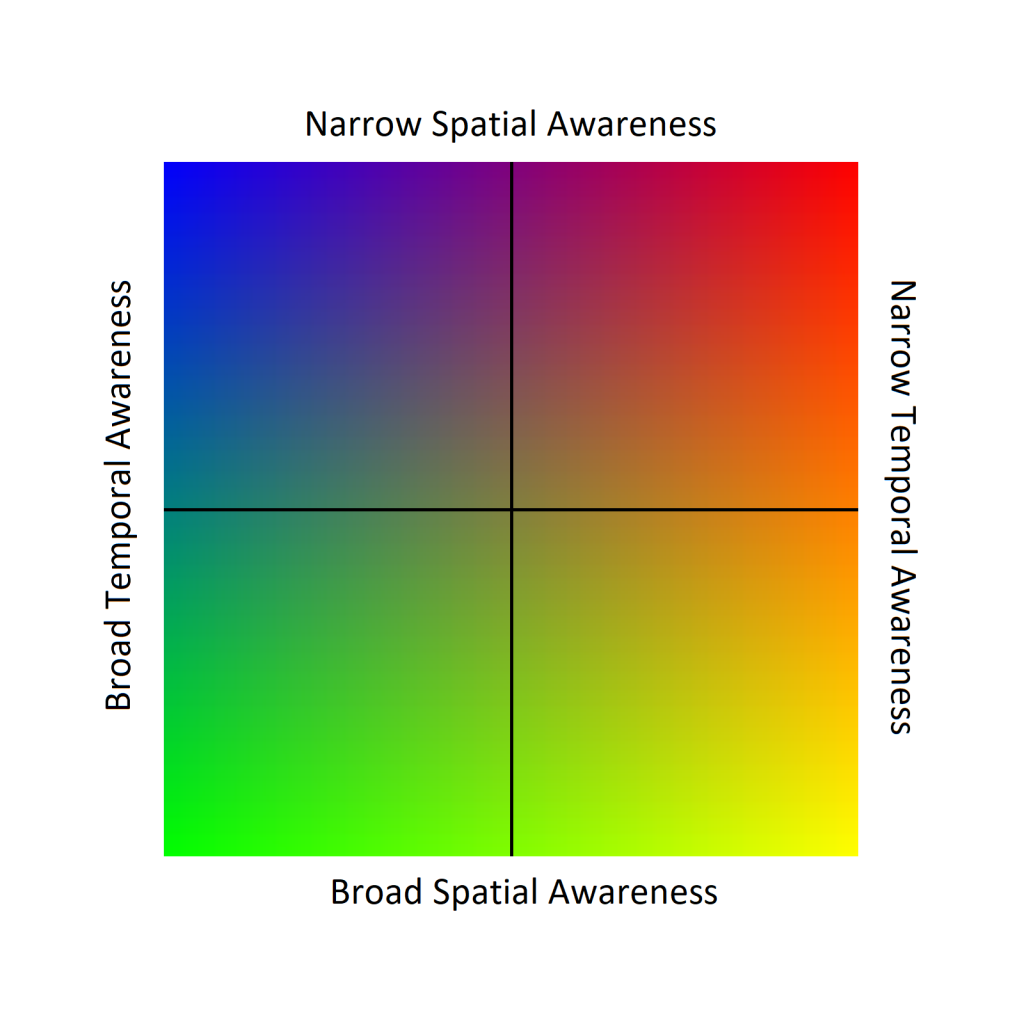
However, people are adaptable, and a good measure of maturity or mental health might be how easily and how far a person is able to change their behavior for different situations. Personality should not be viewed as a single point, but as a density profile over the map, with highest density at the core personality location, and lower density in areas that are difficult for the individual to achieve.
Ideally, we should be able to adapt our spatial and temporal awareness to whatever level is necessary to make the best choices under any given set of circumstances. Awareness is controlled by mental muscles, which of course are not real muscles, but they work in a similar way. The brain is a learning network, so it can learn to do whatever it needs to do. If we exercise the mental muscles that we wish to develop, then they will strengthen and be able to carry out their functions with less effort.
The four personality categories seem to align roughly with the 4-color scheme of the DISC (Drive/Dominance, Influence, Steadiness, Compliance/Conscientiousness) model. This gives us a convenient and memorable way to label the four categories. I’ve chosen to color the map according to those labels, as follows:
- Narrow spatial, narrow temporal: Red (D)
- Broad spatial, narrow temporal: Yellow (I)
- Broad spatial, Broad temporal: Green (S)
- Narrow spatial, broad temporal: Blue (C)
Connection to the Big Five
The Big Five refers to the well researched set of five basic fundamental traits that are typically used to categorize personalities. Each of the Big Five traits can be roughly matched to a particular configuration of spatiotemporal awareness on our map. Some research has been carried out on this subject here and here, which helps to guide the connections.
Agreeableness: Agreeable people are highly interested in other people and are keenly aware of their feelings and needs. They consider the people around them when making decisions. They see others clearly and are less focused on themselves. This requires a broad spatial awareness. Agreeableness has been shown to correlate roughly with (S) and (I) from the DISC model, which are the green and yellow areas on the map, leaning more toward the green side. It also shows a negative correlation with (C) and (D), the blue and red regions, especially the red region. This means that agreeableness is best placed at the bottom of the map, shifted slightly to the green side.
Extraversion: Extraverted people are assertive and energized in social situations and dislike being alone. They are highly connected to the current environment and have a need for external stimulation. This indicates a broad spatial awareness that allows them to absorb their environment, as well as a narrow temporal awareness, since what’s happening right now has the greatest effect on their mood. Extraverted people are living in the moment, without many worries that would prevent them from being present and fully expressing themselves to others. Extraversion, as defined in the Big Five schema, has been shown to have a positive correlation with yellow (I), and a negative correlation with blue (C), which means it belongs in the bottom-right corner of the map.
Conscientiousness: Conscientious people are organized and goal oriented. They think about their place in time and plan ahead. They pay attention to details and are not easily distracted. These behaviors indicate a broad temporal awareness and narrow spatial awareness. A person like this might know exactly what they will be doing next Friday at 12:30, but they might not know that someone is currently standing right behind them. Conscientiousness was shown to have a slightly positive correlation with blue (C), leaning towards green (S), and a slightly negative correlation with yellow (I). We will place conscientiousness in the blue area, on the side closest to green.
Openness: Openness refers to being curious and eager to jump into new ideas and experiences. Open people have many interests and do not feel strongly tied to anything. Compared with others, open people can easily move to a new country, change careers, or find a new partner without stressing too much about it. They have no problem changing plans, which indicates a narrow temporal awareness. They also apparently have little difficulty seeing all the possibilities out there, indicating a more broad spatial awareness. When you can see everything and have no worries about the future or regrets from the past, nothing holds you back from jumping into new experiences and exploring new ideas. Researchers found a correlation between the Big Five’s Openness and yellow (I), leaning towards red (D). There was also a negative correlation with green (S), leaning towards blue (C). This suggests that the Openness dimension runs left to right on the map, where the right side is more open.
Neuroticism: Neurotic individuals are emotionally unstable and tend to worry about many things. This trait seems to be related to a narrow spatiotemporal awareness, such that one subject occupies your mind excessively. It seems to me that if a person widens their focus, being grateful for the past, having hope for the future, and being aware of others and their needs, then neuroticism is less likely. Neuroticism has been shown to correlate positively with red (D) and negatively with green (S), which means it fits best in the upper-right corner.
Here we can see the Big Five traits placed in their rough locations around the personality map.

Connection to Myers-Briggs
The Myers-Briggs categorization of personalities is arguably the most popular, if not the most researched. This categorization is based on a theory developed by Carl Jung, in which he assumed that humans experience the world based on four psychological functions: sensing, intuition, feeling, and thinking.
The divide between introversion (I) and extraversion (E) has the most significant effect on social development and therefore is the main dividing factor for personalities. Extraversion in the Myers-Briggs system seems most closely related to narrow temporal awareness. It is important to note that the Extraversion of the Myers-Briggs system is not necessarily identical to the Extraversion of the Big Five. It seems to me that the difference is in social ability versus social enjoyment. The Myers-Briggs Extraversion seems to indicate how easy it is for a person to communicate effectively with others, which makes it applicable to the workplace, while the Big Five Extraversion indicates how much a person actually enjoys spending time with others, which makes it more applicable to social life. Yellow and red seem to have Myers-Briggs Extraversion, while Yellow owns Big Five Extraversion.
The next divide is whether the person obtains information about the environment through the senses (S) or through intuition (N). Those who intuit information will rely more on their own mind, while those who sense information will be more connected to the external environment. Sensing seems to me to be directly related to broad spatial awareness.
The next division is thinking (T) versus feeling (F). Thinking individuals make decisions rationally without taking people’s feelings too seriously, while Feeling individuals care more about how others will be affected. Feeling involves a social awareness, like empathy, which could be considered a sub-division of spatial awareness.
The last division is judging (J) versus perceiving (P). Judging in this context is related to how a person manages themselves. Judging individuals will organize their activities and plan ahead, while Perceiving individuals will be more open to spontaneity. These characteristics clearly lie in the temporal dimension.
Assuming that Extraversion/Introversion and Sensing/Intuiting are the dominant sources of division, and that the other two dimensions are secondary, we can organize the Myers-Briggs personalities as follows:
IN: blue
- INTJ Architect/Mastermind: bluish blue
- INTP Logician/Architect: reddish blue
- INFJ Advocate/Counselor: greenish blue
- INFP Mediator/Healer: yellowish blue
IS: green
- ISTJ Logistician/Inspector: bluish green
- ISTP Virtuoso/Operator/Crafter: reddish green
- ISFJ Defender/Protector: greenish green
- ISFP Adventurer/Composer/Artist: yellowish green
EN: red
- ENTJ Commander/Field Marshall: reddish red
- ENTP Debater/Inventor: bluish red
- ENFJ Protagonist/Teacher/Giver: greenish red
- ENFP Campaigner/Champion: yellowish red
ES: yellow
- ESTJ Executive/Supervisor/Director: bluish yellow
- ESTP Entrepreneur/Promoter/Persuader: reddish yellow
- ESFJ Consul/Provider/Caregiver: greenish yellow
- ESFP Entertainer/Performer: yellowish yellow
Summary
A complete map containing the spatiotemporal awareness dimensions, the Myers-Briggs personalities, and the Big Five regions is shown below.

While not totally scientific and highly speculative, this organization of personalities helps me to be aware of what kind of person I tend to be and where I can improve. It also helps me better understand others whose abilities are either limited or magnified because of the default configuration of their neural network.
One important thing to remember is that we are not stuck at one place on the map. We are all capable of changing our spatiotemporal awareness and our behavior. We are free to move around the map, although it takes energy to move from our default state.
Ideally, our brain should be capable of maintaining an awareness that is both focused and broad in the spatial and temporal dimensions. We should be able to live in the present moment while being connected to the past and conscious of the future. We should be able to connect with one person at a time while being aware of others. We should also be able to care for ourselves at the same time. A healthy mind should be capable of all good behaviors, properly adapting its capacities to any given set of circumstances.

 Truth Reconciled