
Why is there something rather than nothing? How does the universe exist? Why is there anything at all? How and why did existence win out over nothingness? I have heard and seen such questions asked on many occasions, but I have always been disappointed when it is concluded that the question of existence is unanswerable or might not be answered for a very long time.
My perspective on the subject is as follows: either the question of existence can be answered or it cannot. If it cannot be answered, then we should at least be able to prove that it cannot be answered. One example of such a question is the continuum hypothesis from mathematics. It has been demonstrated that the continuum hypothesis cannot be proven nor disproven under the accepted axioms of mathematics. No one has provided a similar proof to show that the question of existence cannot be answered.
On the other hand, if the question of existence does have an answer, then we should be able to find it. Furthermore, the answer should not be too complicated nor require highly advanced mathematical and logical reasoning, because the very beginning of all things should not have so much structure to deal with.
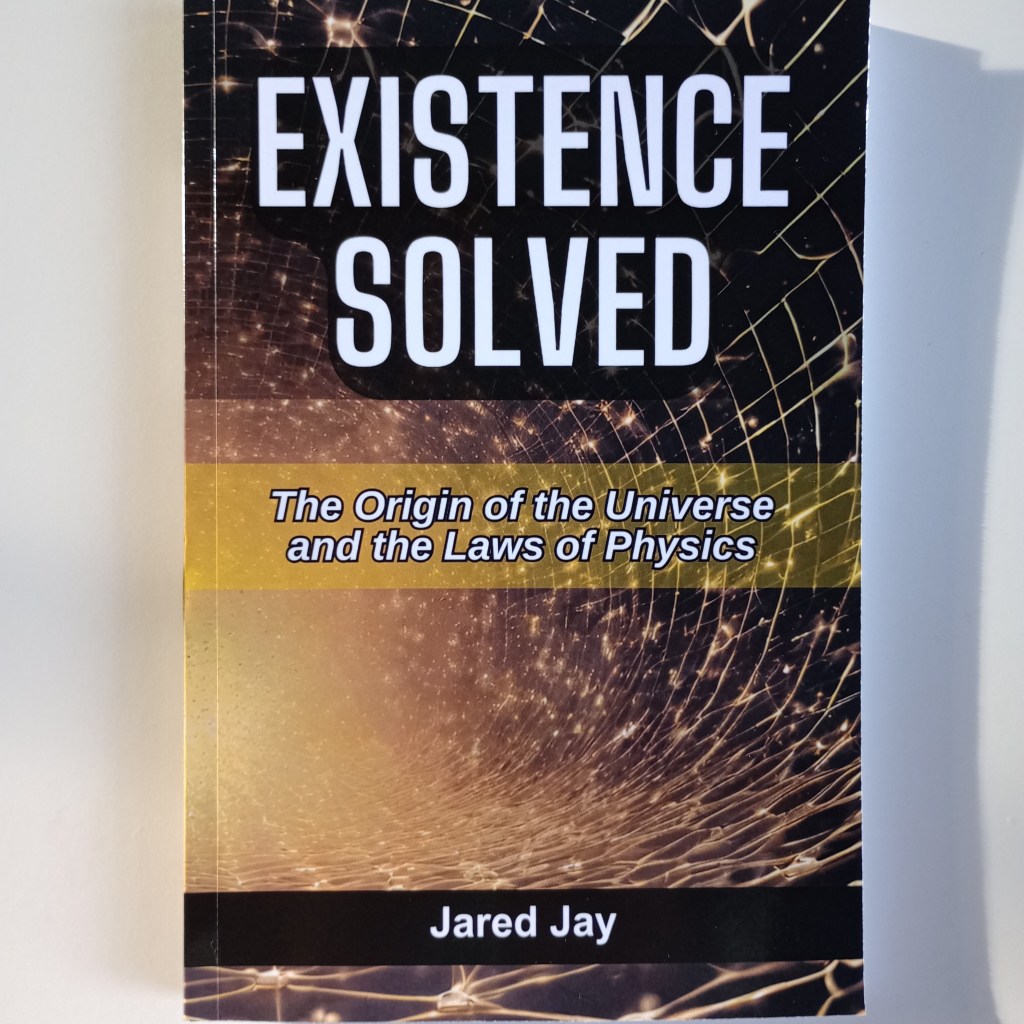
A new theory claims to have solved the mystery of existence completely. The tautological explanation of existence is laid out in detail in Jay’s Existence Solved: the Origin of the Universe and the Laws of Physics. The full text is available to read online. The explanation follows from logic alone and does not require the prior existence of an all-powerful god or any other kind of unexplained universe-creating environment or mechanism such as a quantum vacuum or an infinite multiverse. This does not imply that such entities do not exist, only that they are not necessary to explain the origin of existence.
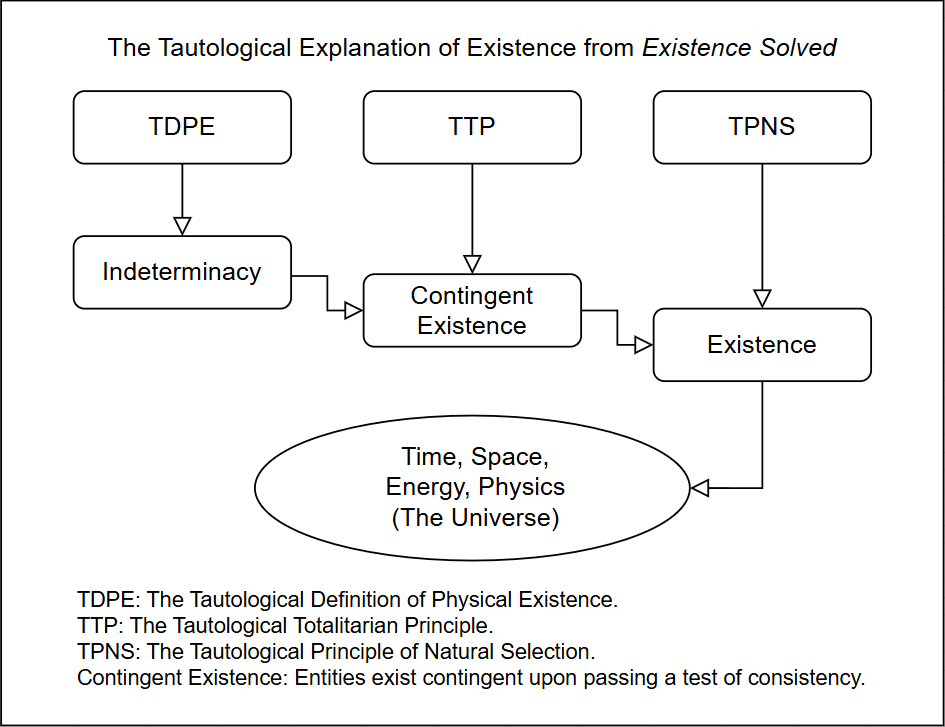
In this essay, I will present the explanation of existence as simply and succinctly as I can manage. The main flow of the argument is shown in the diagram at the top of this essay. Three irrefutable premises, the tautological definition of physical existence, the tautological totalitarian principle, and the tautological principle of natural selection, are the foundation of the argument.
The explanation requires a basic understanding of logic, including logical formulae, truth values, and tautologies. It introduces the new concept of contingent existence, but little more than that. Despite its simplicity, the explanation for existence allows for a universe of infinite complexity and sheds light on many previously unexplained mysteries in physics.
Previous Attempts
To better appreciate the solution, let’s briefly review some of the issues that have come up in previous attempts to answer the question of existence.
The most common attempted explanation is God. The argument goes as follows: it is impossible for something to come from nothing, so the universe must have come from something. The order in the universe seems to be evidence of intelligent design, and thus we conclude that the universe was created by an all-powerful and all-knowing being we call God. The glaring issue with this explanation, even if it is true, is that we have not actually answered the question. There is still a highly complex being whose existence remains unexplained. Why was God there in the first place? How did he come to be? Why does God exist instead of nothing?
Apart from God, the most common attempts to explain the origin of existence are based on the Lambda-CDM model of cosmology (The Big Bang), which is constructed from our most successful theories of physics combined with evidence collected from several independent types of observations. But our current understanding only allows us to explore the history of the universe back to its initial state. Physics does not tell us how the primordial universe was created in the first place. Any theories of what happened before the Big Bang are still in the realm of speculation.
Some theorists have postulated that random vacuum fluctuations could have generated the universe from nothing, as in Krauss’ A Universe from Nothing. However, a physical vacuum with the potential to generate particles is certainly not the same as nothing. Why was the vacuum present in the first place, and where did those laws of quantum mechanics come from? Some have suggested that our universe is only one of many with random sets of laws, and that this particular universe just happened to have a winning structure that allowed for the development of complex organisms. But still, why was there a multiverse with random sets of laws to begin with instead of nothing?
Every previous attempt at explaining the existence of the universe involves assuming, without explaining, the prior existence of some kind of universe-creating entity, such as God, quantum fields in a vacuum, the multiverse, etc. In every case, the assumption is not guaranteed to be true, but is only hypothesized, and we are always left with the question of why that prior entity might have existed in the first place. With each attempted explanation, the question of existence gets pushed into deeper territory, but still remains unanswered. Every previous attempt at an explanation has been, at best, incomplete.
A Complete Explanation
What we are looking for is a “complete” explanation. We want an explanation that is so thorough that there is nothing left to explain and there is no room for doubt. A complete explanation must not rely on any unproven assumptions. It must be guaranteed to be true, no matter what. Any explanation that does not satisfy these requirements is insufficient, because it will leave us with unanswered questions about the assumptions involved.
In order to properly answer the question of existence, we must first write down a definition of the word “existence.” We run into a problem here already, because almost any definition we can think of will contain an unexplained assumption. For example, if we say that existence is matter or energy, then we are left wondering, why is that existence? Why does existence take this form instead of another? Why does it have so many complex properties? Why does it follow laws? What are matter and energy anyway? Why is this the starting point? Why wasn’t it something else?
We must go deeper than this. In fact, we must go all the way down. What is the fundamental meaning of existence, and how can we be one hundred percent sure that it is correct? Is it possible to define existence in a way that involves no assumptions and that is guaranteed to be true?
It turns out, there is only one possible definition of existence that can satisfy the requirements of a complete explanation. To understand this, we must first understand logical tautologies. In the study of logic, a tautology is a logical formula that is guaranteed to be true in all cases due to its intrinsic structure. One example of this is the famous syllogism: ”if P, and P implies Q, then Q.” The syllogism is always true regardless of the content of the statements P and Q. Tautologies such as the syllogism form infallible rules that can be used to build irrefutable arguments.
It can be shown that only a tautological definition of existence can satisfy the requirements for a complete explanation. The only way to make the definition of physical existence tautological is to make it circular. In other words, an entity exists physically if it exists physically. This is as far as we can take the definition, a priori, if we want a complete explanation for physical existence.
If you feel inclined to disagree, I encourage you to try thinking of a defining characteristic of physical existence that you would prefer to use in the definition. Now tell me, why is that the defining characteristic? How can you be sure? Why wasn’t it something else? Why did physical existence choose to be defined in that way instead of a different way? How can you convince me that you are right if I disagree with you?
As you can see, there is much left unexplained if we start the explanation with an arbitrary defining characteristic. However, we will see that the fact that the nature of existence cannot be predefined is exactly what causes it to obtain the properties that it has.
The Totalitarian Principle
There is not much that we can do with a circular definition. The most it can do is tell us that the existence of any possible entity is logically indeterminate. This is not necessarily a roadblock. In fact, it reminds me of the principles of indeterminacy in quantum physics, which gives me the impression that we are on the right track. Besides, there are still other tautologies in our logical toolkit that can help us solve the mystery of existence. One that turns out to be particularly useful is the Tautological Totalitarian Principle.
The Totalitarian Principle was first introduced by physicists working on the mechanics of quantum field theories. It is often quoted as “Anything that is not forbidden is compulsory.” In the context of quantum field theory, this statement means that any quantum event or interaction that can possibly happen must necessarily happen. It follows that the evolution of any quantum system is given by a sum over all possible futures. Most of those futures interfere and cancel each other out, and what we are left with are special extremized trajectories that manage to escape the cancellation. No one knew exactly why nature behaved in this all-inclusive way, but the assumption provided accurate results.
It is now known that the Totalitarian Principle, in at least one particular form, is a logical tautology. It is true by the very nature of how it is expressed. The tautological statement reads as follows: “If A exists, then B exists if and only if the existence of B does not contradict the existence of A.” One can prove that this statement is true in all cases by means of a truth table. Essentially, this statement forces the existence of anything that can possibly exist, as long it does not contradict any other existing entities.
Contingent Existence and Natural Selection
However, we still cannot determine whether or not any specific entity exists. We have a circular definition of existence that appears to be of little use, and now we also have the totalitarian principle that could help us determine everything that exists, but only if we already know of at least one entity that exists. At this point, we can’t be sure of what can exist, so the totalitarian principle remains inactive. We seem to be running in circles. Existence is still indeterminate. We need one more ingredient to complete the explanation.
Although we cannot yet determine what exists, we can say what types of entities have the potential to exist. The list of possible entities includes any entity that is consistent with itself. Square circles are excluded, for example, as well as integers that are both odd and even, because such entities are self-contradictory. According to the totalitarian principle, all self-consistent entities should exist as long as they don’t contradict any existing entities.
This is the concept of Contingent Existence, the state in which the existence of an entity is possible, but not confirmed, and is contingent upon passing the test of consistency provided by the totalitarian principle. At this point in the logic, all self-consistent entities have the property of contingent existence. Any contingent entity that passes the test of consistency with all the other contingent entities must necessarily exist, while those contingent entities that contradict each other cannot attain physical existence.
This is where the principle of Natural Selection comes into play. That which tends to survive tends to survive. It is yet another tautology. It implies that the entities that exhibit properties conducive to their own survival will dominate existence. In other words, entities that are not contradicted by others and do not contradict others will become the building blocks of the universe and will dictate the laws of physics.
Time, Space, and the Laws of Physics
Those entities that manage to pass the test of consistency with all other possible entities attain the status of physical existence. These entities form the initial state of the universe, but creation does not end there. The totalitarian principle, being always and absolutely true, still requires us to test all possible entities against this new set of physically existing things. Once again, all possible entities attain the status of contingent existence. At this second iteration of the logic, there is a physical universe that serves as a baseline. Any contingent entity that contradicts the physical universe will fail the test of consistency and cannot exist. Those that agree with the physical universe and with all the remaining contingent entities will attain physical existence. This process then repeats forever.
We have uncovered a never-ending logical process that brings entities into existence continuously. The universe is constantly refining and defining itself at each iteration of the test of consistency. The steps of this process are timeless, abstract, mathematical operations, but for an entity existing within these operations, the steps of calculation are experienced as a forward flow of time. The various timelines that emanate from each step fill an abstract mathematical space that is experienced as physical space. A coordinate parameterization of this space of entities can be shown to obey the rules of special relativity, in perfect agreement with modern physics.
The book Existence Solved addresses a complicating possibility that all entities might have an opposite and could thus cancel out to nothing. The subset of entities that carry the property of randomness resolves this issue and allows the creation process to unfold normally. It follows that the foundation of existence is dominated by randomness. Possibilities arise and collapse continuously and randomly as entities are driven toward existence and tested one against another.
The entities that preserve themselves through time by continually passing the test of consistency become the matter and energy of the universe. Thus we obtain the law of conservation of energy, as all energy preserves itself through time by definition. However, we find in addition to this a continual creation of new energy, but it happens at such a slow rate that it is imperceptible except at cosmic scales (approximately 10^-44 kg/s/m^3). On the other hand, many entities that fail to preserve themselves can still have an effect on the evolution of matter. These transient entities are reminiscent of the virtual particles of quantum field theory.
A mathematical model of the generated physical entities and their interactions takes the form of a generalized theory of physics. This theory can be shown to reduce to General Relativity and the Standard Model of Particle Physics under appropriate restrictions. Interestingly, the theory seems to support a new kind of steady-state model of cosmology, in contrast with the leading Big Bang theory.
Summary
To sum up, the question of why the universe exists has been answered in a way that is complete, logical, and in agreement with modern physics. No assumptions were necessary, because the premises of the theory are logical tautologies that are objectively true by their nature. The main ingredients are the tautological definition of existence, the tautological totalitarian principle, and the tautological principle of natural selection.
The tautological explanation for existence paves the way for a better understanding of the nature of the universe and its laws. Having no prior structure, physical existence necessarily undergoes a constant exploratory process of defining itself. Quantum indeterminacy and randomness arise naturally. Time, space, and energy emerge from the structure of the never-ending logical calculation of existence. All the laws of physics follow, shedding light on many mysteries along the way. We no longer need to ask where the universe and its laws come from; we need only think about what we can do with them.

 Truth Reconciled