
All of us have observed or taken part in discussions about right and wrong. In many instances, especially in the comments on social media, such discussions are thoughtless and shallow. In some cases, however, the discussion can go deeper, and we begin to uncover the values and assumptions held by the individuals involved in the discussion.
Inevitably, if the discussion goes deep enough, we get to the ultimate moral question: Does objective morality really exist? If it doesn’t, then there is no right or wrong action to take in any situation, and our efforts to persuade others to our point of view are pointless. The whole discussion becomes meaningless, supported only by our unfounded beliefs and opinions, with no real foundation in truth.
Without objective morality, every moral argument must end there, when each person realizes that their understanding of right and wrong is based on certain unfounded assumptions that they hold. Some believe that right and wrong are defined by God, and that without God there is no morality. Others believe that right and wrong are defined by what brings the most happiness or misery to mankind. These beliefs are assumptions. If you hold beliefs such as these, a skeptic can always simply brush aside the foundational assumptions of your moral compass and reasonably ignore everything that you have to say.
Until recently, no one has ever been able to prove that morality exists objectively and independently of what anyone thinks or believes. Many have concluded (without proof) that morality cannot have an objective foundation. Some have used this as an excuse to do whatever they please, ignoring all moral tradition and guidance, because in their view, it is all meaningless anyway. No one can tell them how to behave, because there is no objectively “right” way to behave.
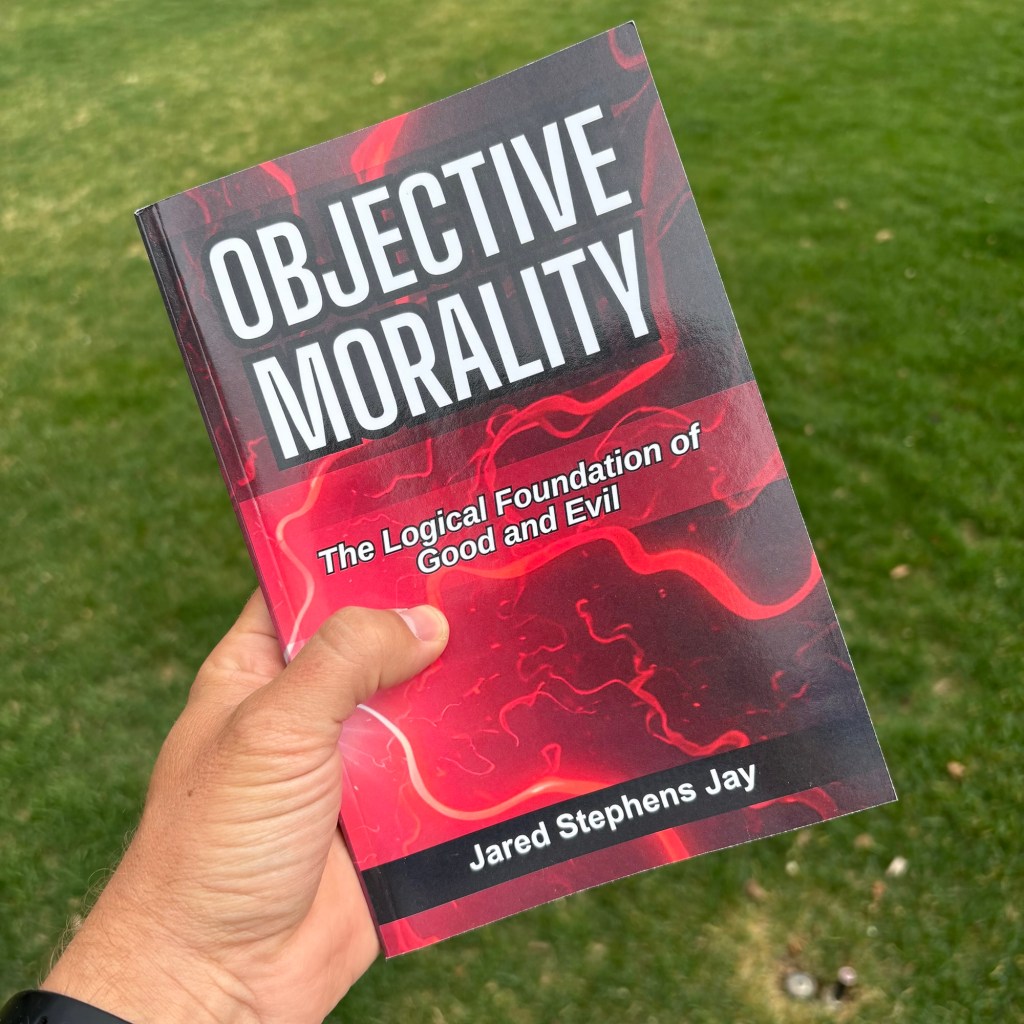
But a new theory of morality has come to the rescue. The Tautological Theory of Morality claims to have grounded morality in objective truth without assumptions, in such a way that the existence and authority of morality can no longer be rationally denied. First described in this blog, and now published in Objective Morality: The Logical Foundation of Good and Evil, the new theory places moral philosophy on solid ground and unifies other theories of morality under its umbrella.
The development of the new theory of objective morality is as follows.
First (The Definition of Morality): We define morality as the rule or set of rules that defines which actions are right in any given situation. What those rules are, exactly, is yet to be determined.
Second (An Irrefutable Foundation): We clarify the goal of this argument: We require a true and irrefutable foundation for objective morality. We recognize that an irrefutable foundation cannot rely on any presupposed rules or assumptions to determine what is right or wrong, because those assumptions could be easily denied by a critic.
Third (Tautological Morality): With no presupposed rules or assumptions, the rightness or wrongness of an action can only be determined by morality itself. Even though morality does not yet have a clear foundation, it is still defined as the concept that differentiates between right and wrong.
Fourth (Self-supporting Behaviors): Without assuming anything, the value of an action can only be measured based on how much additional moral behavior it generates. Basing the value of an action on any other supposedly valuable result, such as increased happiness or well-being, would constitute an assumption that could be easily denied. One can always ask, “Why is that particular consequence valuable?” But moral behavior is good by definition, and thus a consequence defined by increased moral behavior is unequivocally good. We can deduce from this that morality is a set of rules that tend to lead to more adherence to themselves, and that the best actions are the ones that lead to the most adherence to morality.
Fifth (The Eternal Perspective): Actions that preserve adherence to themselves for eternity are the most moral, because a consequence of eternal duration is infinitely greater than a consequence of finite duration.
Sixth (Objective Morality): We find that morality must consist of a set of rules that preserve adherence to themselves for eternity.
We have thus developed a theory of morality that can be described as tautological, because morality defines itself. This derivation of morality is fully objective, because it follows from pure logic and is independent of the opinions of people. Through logical analysis of many hypothetical situations, one can use this foundation of morality to derive the optimal rules of behavior for societies.
This theory of morality has also been shown to be perfectly self-consistent, which implies that it exists on par with other abstract concepts that govern the universe, such as the laws of physics. Thus it has been proven that objective morality exists and carries the same level of authority as physics. Any other society of intelligent beings could potentially discover the same theory, and derive from it the same laws of good behavior. It is inevitable that any such society, including our own, must eventually adhere perfectly to objective morality or cease to exist, because the behaviors prescribed by morality are the only ones that are capable of preserving themselves forever within a society.
The rules that are derived from objective morality tend to be consistent with what humans have typically believed to be right, demonstrating its effectiveness as a prescriptive theory of ethics. The development of the theory and many applications are discussed in detail in the book. Many of the foundational concepts are also discussed in previous articles that I have written on the subject of morality, which can be found here.

 Truth Reconciled