
Introduction
This post is about a religious topic common to most Christian denominations: the Book of Revelation written by John, the last living Apostle of Christ. Specifically, I will attempt to identify what was meant by the two main villains in the story. The first is “Babylon” or the “Great Whore.” The second is the “Beast.” Before I set you up for disappointment, I must let you know that I do not identify them as particular individuals or nations, but rather as cultures.
The heroes of the story are Christ and his kingdom. They are presented as the underdogs from the beginning, but with the assurance that they will win in the end. The Beast and Babylon both hate Christ and his kingdom. The Beast tries and fails to destroy the kingdom of God before it is born. The Beast is wounded and seemingly ceases to have power while Babylon takes over. Eventually, the Beast rises again and destroys Babylon. The Beast then attempts once more to destroy the Kingdom of God but is ultimately defeated at Christ’s second coming.
Multi-use Prophecies
I am aware that there are differences of opinion on the applicability of John’s prophecies to the events of the last days. The descriptions of the Beast align extremely well with the Roman Empire in the first century and specifically with the Emperor Nero. Nero was the one persecuting the saints and attempting to destroy the kingdom of God. Nero is 666 in Hebrew and 616 in Latin and Greek, matching the various translations of the text perfectly. Rome was built on 7 hills and was known as the city of 7 hills, which agrees with the biblical description of the Beast. Anyone who lived in the days when the book was written would have believed it spoke of Rome.
The question is, why did God want us to have this book if it doesn’t tell us about things to come? Why is it widely regarded as a prophecy of the end times if it was actually about Ancient Rome? For those of the Church of Jesus Christ of Latter-day Saints especially, the Book of Mormon confirms that John was appointed to write about what would occur after the end of Nephi’s prophecy and before the Second Coming of Christ. How can we reconcile these two different interpretations of the Book of Revelation?
This isn’t the first time that a prophecy such as this has been written. In the Book of Daniel we can find apocalyptic prophecies that are very similar to those of the Book of Revelation. The vile person in the Book of Daniel clearly refers to Antiochus who invaded Israel and stopped the daily sacrifice for 1260 “morning-evenings” or 630 days. Still, Daniel’s prophecies are also considered to be applicable to the last days.
Antiochus and Nero both died during their attempts to destroy God’s people. Their powerful kingdoms did not last. It seems that this is the usual pattern that the world follows when societies are collapsing. Perhaps this is what makes the Book of Revelation applicable to our day. “History repeats itself,” as they say, because humans will be humans. The prophecies given by Daniel and John are apparently general enough and typical enough that they can apply to several distinct but similar periods of time.
Predictions and Plans
Now we must answer another important question. Did John really see future events? Is such a thing even possible? Physicists know that we cannot always predict how physical systems will evolve with much precision, let alone people. Predictions are limited by our understanding of how things work and by our ability to accurately measure every detail of the initial state of a system. Even if we have a perfect understanding of all the laws of physics, an incomplete picture of the current state of the universe will result in inaccurate predictions of the future. In chaotic systems, which are common in nature, an arbitrarily small difference between measurement and reality can result in vast differences between predictions and actual outcomes. Such systems are inherently unpredictable.
But it gets even worse. Freedom is an inherent property of nature at the most fundamental level of existence. Physical interactions in the quantum realm exhibit intrinsic randomness. Random events, by definition, cannot be exactly predicted.
For these reasons, I’m not convinced that it is possible to know specifics about the future with absolute certainty. I will not discount the plausibility of vague predictions of averaged out large-scale systems. For example, it is not possible to predict the exact path that a particle will take in a hot fluid, but it is possible to make accurate generalized predictions about the overall future state of the entire fluid. I can’t say where each particle of a hot bowl of soup will be located 5 minutes from now, but I can predict with confidence that the temperature of the soup will be lower.
We should also consider the difference between a prediction and a plan. If you have some control over a system, whatever you plan for it will come to pass as long as it is actually achievable and you put in the work to make it happen. When large-scale plans are made by one with as much power and wisdom as God has, I believe we can have extremely high confidence that the plan will be carried out successfully. The details may depend on the unpredictable states of individuals, but the overall story of God’s plan is likely to play out as written.
Given these insights, it seems to me that the main characters in the Book of Revelation should not be interpreted as specific people or nations, but as personalities and cultures that will inevitably develop and play their role in carrying out God’s plan for this world.
Moral Dimensions of Freedom and Righteousness
What kind of cultures could God be so confident about that he was willing to give us a prediction of their rise thousands of years beforehand? Either he plans to meticulously build these evil empires over time (which doesn’t seem like something God would want to do) or they are cultures which inevitably arise over time due to underlying principles of human nature in the context of God’s plan for us.
We know that God is perfectly good, and thus his kingdom is one of perfect goodness. God’s primary mission is therefore the same as that of morality itself: to extend goodness, or morality, as far and as long as possible. (See my essays or my book on Morality for more detailed explanations of why this must be the case.)
Morality is only possible when these 3 pillars are present:
- People: A population of individuals exists.
- Freedom: The individuals are free to choose their behavior.
- Righteousness: There are individuals within the population who choose to follow the laws of morality.
Pillar number 1 is a given. Pillars 2 and 3, however, vary significantly across cultures and across time. Some populations experience a great wealth of freedom, while others live in captivity. Some cultures thrive on the righteousness of their people, while others decay in immorality.
The two dimensions of freedom and righteousness can be used to plot a map of possible cultures, as shown in the figure below. The independent variable on the x-axis is righteousness, because it is what we have the most control over. There is greater righteousness on the right side of the plot and greater wickedness on the left. The dependent variable on the y-axis is freedom, because it depends somewhat on the righteousness of the people.
The kingdom of God is perfectly righteous and enjoys uninhibited freedom to carry out their righteous acts, and therefore it sits in the upper-right corner of the plot. This is the point where morality is maximized. The kingdom of Satan, or Hell, lies at the opposite end of the spectrum, in the lower-left corner, where all suffer in hopeless captivity and desire evil continually.
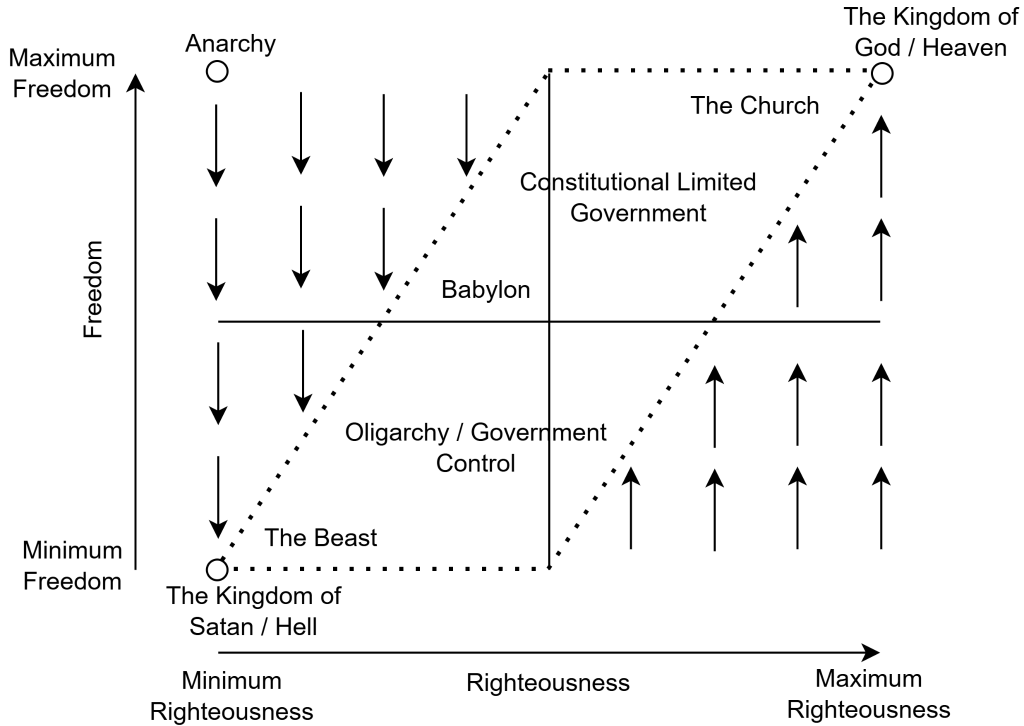
The lower-right corner corresponds to the case of completely righteous people who are kept under total control. This was apparently Lucifer’s counter plan during the war in heaven, but it didn’t work out. Although not shown in the plot, this situation often leads to evil. As the saying goes, “power corrupts, and absolute power corrupts absolutely.” But not only is the leader corrupted, but often the people as well. We all seek to make our own choices, so when we are forced to act a certain way, even if it is technically good, we resent it and desire to resist. But still, it is always our choice to become evil, which is why I didn’t draw arrows pointing to the left.
The upper-left corner is the region of anarchy, where a culture enjoys total freedom while drowning in a deluge of evil. Anarchy is always violent and unstable. It only lasts until one party conquers the others. Thus, this region tends to slide towards captivity, as indicated by the arrows in the upper-left that all point downward. In fact, any culture experiencing a high amount of unrighteousness will tend to slide deeper into captivity, because a nation that cannot behave itself must enslave itself in order to preserve itself.
In contrast, righteous societies tend to slide towards greater freedom, because they can be trusted to do what is right and they tend to produce good leaders. This is indicated by the arrows in the lower-right portion of the plot that all point upward. Restrictions get in the way of their righteous desires, and so the nation will tend to remove those restrictions over time. In the cases where a tyrant has power over a righteous people, morality will impel them to fight for their freedom and the freedom of future generations, and because of their righteousness, they will likely succeed.
Two Types of Stable Government
The region in the center of the map, extending from the lower-left corner to the upper-right corner and enclosed by dashed lines, represents the region in which stable societies can exist. Societies can extend to regions of freedom and righteousness outside this domain, temporarily, but they will always come back into this region. It is simply a matter of re-organizing their government to match culture.
There are infinitely many different ways to organize a government, but not all of them will endure the test of time. Many will grow in power and gain greater control over the people, until just a few individuals hold absolute authority over the whole nation. This is called an oligarchy. This sort of government is stable, but not in a peaceful way. There may be coups and revolutions, but the society almost always ends up in oligarchy again. This includes most dictatorships and other types of totalitarian governments where one person “supposedly” holds all power, because a leader always relies on a select set of counselors, generals, or agents to help them govern.
Other types of governments may lose power due to inherent weakness or by actions of the people. If they cannot find a stable level of limited power, then they will inevitably fall powerless and dissolve into anarchy or take control and evolve into oligarchy. In the case of anarchy, oligarchy will soon develop when one faction conquers the others.
Another form of stable government involves using the rule of law to limit the power of all factions within a society. This is referred to as constitutional limited government. This type of government, if it is well organized with appropriate checks and balances, will preserve itself peacefully. Regime changes can occur through elections rather than revolutions. This type of government offers greater freedom to the people, because they are not governed by one type of opinion.
Oligarchy and constitutionally limited government are the 2 stable forms of government that can exist in our imperfect world. A society that is organized in any other way will evolve into one of these. The Beast and Babylon each likely involve cultures that are governed by one of these two types of government.
Babylon, the Great Whore
Coming back to the Book of Revelation, let’s try to identify the location of Babylon, or the Great Whore, as John calls it, on our map of freedom and goodness. We read that Babylon desires evil and kills the saints of God, which clearly places it somewhere near the left side of the map. However, Babylon never tried to completely destroy the church, which indicates to me that it is not at the same level of evil as the Beast. We also read that Babylon is full of merchandise and pleasures and makes many men wealthy, indicating a high degree of freedom, but not enough to reach unstable anarchy.
It seems to me that Babylon refers to the culture of materialism, consumerism, and pleasure seeking that is so rampant in our mostly free world. The people of Babylon worship wealth, power, pleasure, and man-made objects. None of these things have real intrinsic value, and the love of them drives us away from God.
This Babylon was formed long ago with the rise of the merchant class. It has grown more powerful over time with the progress of freedom and limited government throughout the world. The old ways of living are practically eliminated, as the Great Whore now sits upon many waters, spreading her influence across all the earth.
Freedom itself is not evil, but using our freedom to walk away and even fight against the kingdom of God is evil. The rise of freedom was objectively good for the world. Freedom is necessary to make our world more like heaven. Freedom needs to be preserved. Babylon is an enemy of God not because it is free, but because it chooses evil over good.
I placed Babylon on the most wicked side of the region of constitutional limited government. Notice that if Babylon’s wickedness increases, it will shift left into the unstable region of the map. In this area, it will drift downward into captivity and oligarchy. It will fail because of its wickedness. If Babylon’s wickedness is great enough, it will be consumed by the area that I have labeled “The Beast.”
The Beast
Now for the Beast. Revelation describes the beast as being under the Great Whore. We are told that it was wounded, and was not, and yet is. The Beast has 7 heads and 10 horns. The 7 heads signified 7 mountains with 7 kings. The 10 horns signify 10 kings without kingdoms who receive power for an hour with the beast in the last days.
The beast is clearly evil, which means it lies near the left side of the freedom-righteousness map. The Beast is distinct from Babylon. We read that the beast hates Babylon and destroys it completely. We also read many verses which give the impression that freedom is greatly restricted in the society of the beast. For example, only those with the mark of the beast are allowed to buy and sell. I’m confident that the beast belongs near the lower-left corner of the map, closer to the kingdom of Satan than any other type of society.
I identify the beast as an extremely wicked society with strong government control. This makes sense in the context of history. Oligarchy was greatly wounded during the last few centuries when nations all over the world fought for freedom. Apparently, it will make a comeback in the future, driven by a hatred of Babylon, or by Babylon’s own wickedness.
For a short time, a powerful government formed by a confederacy of many wicked nations will obtain great influence over the world and destroy Babylon, the Great Whore, putting an end to the freedom that was enjoyed for generations. The society of the Beast will be very wicked and anti-Christ, and will favor government control and limited freedom of individuals.
The Kingdom of God Prevails
The Kingdom of God will be on the Earth during the time when the Beast rises again and destroys Babylon. The Kingdom of God is a society of great freedom and righteousness. It represents the church of Christ, or the culture of people who freely and willingly follow the teachings of Christ.
With the failure of Babylon, the growing Kingdom of God will rise to great prominence. A great division will occur in which all people must choose between the Kingdom of God and the Beast. The Beast will abhor the Kingdom of God and will seek to destroy it as it destroyed Babylon, but just as Antiochus and Nero failed to achieve their malicious goals in ancient times, the Beast will fail as well. When the Beast is slain by Christ, only the Kingdom of God will remain on the Earth.
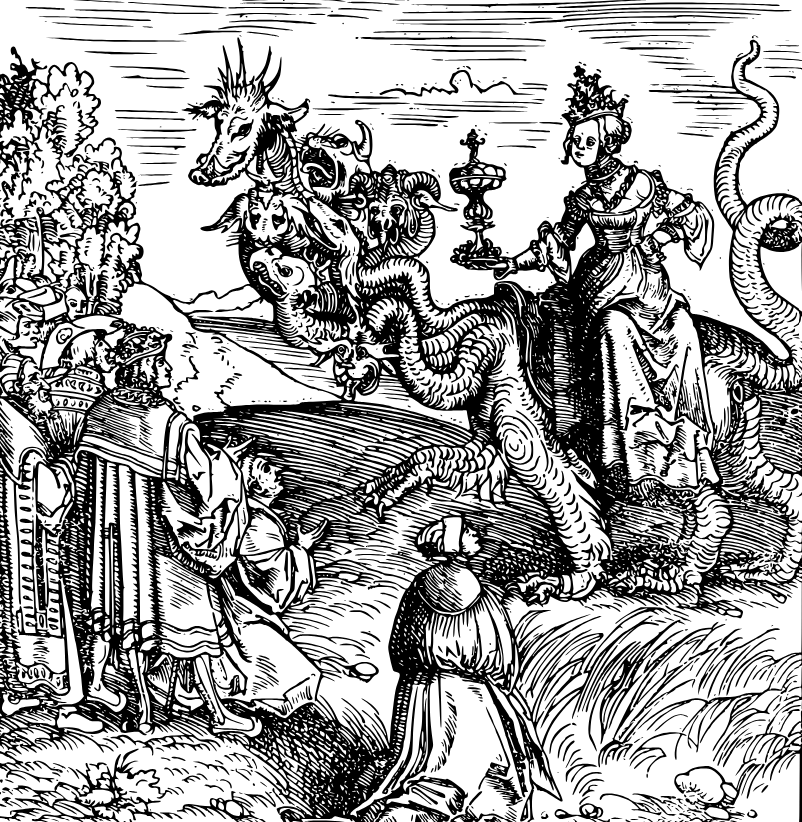
*Post image credit: Vector by openclipart.org on FreeImages


 Truth Reconciled