

Introduction
Imagine you are sitting in your room reading a book. Only one light is on in the room, but that one light is enough for you to read comfortably. Suddenly, someone else comes into the room and thinks it’s too dark, so they decide to turn on another light. Assuming the lights are both equally bright, you will probably notice that the room gets slightly brighter, but it won’t be an alarming change.
Now suppose that instead of turning on the second light, they mistakenly flip the switch that turns off the one light that was on. The whole room suddenly goes dark. This change is alarming, and yet the change is exactly equal and opposite of the first scenario in which one additional light was turned on. Why is the subtraction of light so much more noticeable and distracting than the addition of an equal amount of light?
This phenomenon is not unique to light. The same effect is observed with sound. Adding another speaker to a sound system is not as noticeable as removing a speaker. Adding a fifth singer to a quartet is a small change, but reducing it to a trio is a major change.
Since our basic senses follow this pattern, it makes sense that our whole way of interpreting life follows the same pattern. Any negative experience or possibility is always heavier in our mind than an equally sized positive experience. The excitement of gaining $10,000 is small compared to the disappointment of losing $10,000. Negative reinforcement is usually more motivating than positive reinforcement. Fear of disappointing your supervisors will make you work harder than the hope of pleasing them. The joy of gaining a new family member pales in comparison to the pain of losing one.
This is simply due to the way we process the information around us. Negative experiences are more noticeable than positive experiences. Negative impressions are more memorable than positive ones. Our natural bias in attention towards negative change is not fundamentally emotional, but the effect seems to seep into our emotional world because our interpretation of our experiences starts with our biased senses.
Our logarithmic senses
This phenomenon exists because our senses are designed to observe reality in a way that is both broad and focused. We need to be able to see the whole environment around us, and at the same time be able to notice small changes in it. We need to be able to hear a wide range of noises, from very soft to very loud, and we need to be able to distinguish between very similar sounds. This requirement forces our senses to measure the world on a logarithmic scale instead of a simple linear scale.
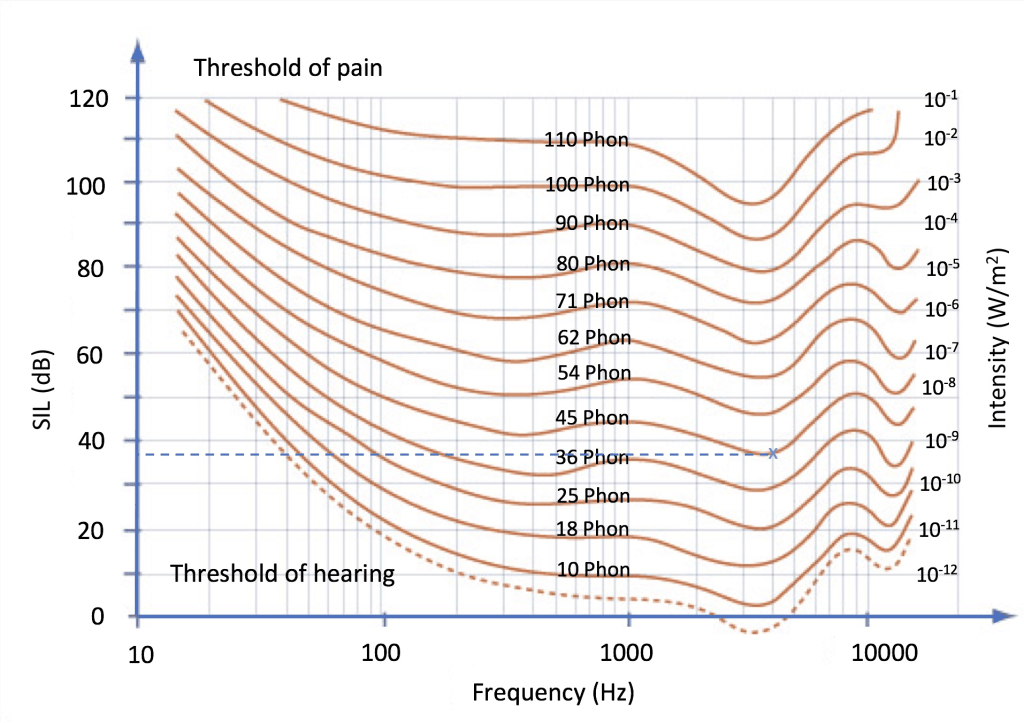
The figure below shows the typical range of human hearing. The horizontal axis is the frequency of the sound, measured in Hertz (Hz), and the vertical axis is intensity or loudness, with various different types of units. The unit of intensity most closely related to what is physically happening in the air, before our senses process the information, is Watts per square meter (W/m^2) shown on the right-hand side of the plot. This measures the energy transferred by the sound through the air per second per unit area.
(*Image borrowed from LibreTexts Physics 3.7.1.3: The Decibel Scale)
The curved lines are “equal-loudness contours” or “isophonic curves.” This means that as you move along the line, the perceived loudness stays the same. Any sound below the bottom line is too quiet to hear. Any sound above the top line will damage your ears.
Now let’s look at the gridlines in the background. Notice that as we go from one gridline to another on up the vertical axis of intensity on the right side, the value of the intensity changes by a factor of ten with each step. The same is true for frequency on the horizontal axis. Instead of a linear scale of 1, 2, 3, it increases as 10, 100, 1000, and so on. This is a logarithmic scale.
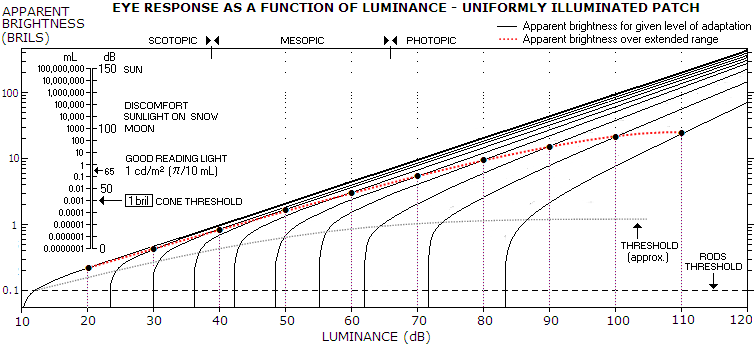
The same is partly true for our sense of sight. The figure below shows the apparent or perceived brightness of light versus a logarithmic quantity called “luminance” with a unit of “decibels” (dB). Every 10 dB increase in luminance corresponds to a factor of 10 increase in the intensity of the light. Sight is more complicated than hearing in this case because the eye can adapt to the light. The black curved lines tell us how the eye responds to luminance at different levels of adaptation, where the far-left line corresponds to an eye adapted to total darkness.
(*Image borrowed from Telescope-Optics.net: 13.8: Eye intensity response, contrast sensitivity: Eye light-intensity response.)
Look at the intensity scale on the left side of the interior of the plot. The scale compares milli-Lumens (mL), a unit of intensity, with dB. Notice that the luminance of the sun is only 50dB higher than the luminance of the moon, even though it is 100,000 times more intense. The eye’s response to brightness—similar to the ear’s response to loudness—is logarithmic.
However, the eye’s response to the frequency of light, or color, is not logarithmic. This is because the eye is designed to focus only on a narrow range of visible frequencies that happen to traverse Earth’s atmosphere. There was never an evolutionary need to experience a wide range of the electromagnetic spectrum.
Sensory bias towards subtraction
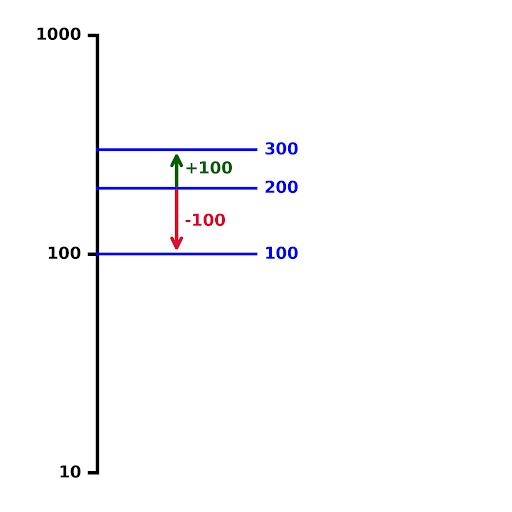
To see why a logarithmic scale causes us to give greater attention to negative change, consider the diagram below. I have drawn a vertical number line with a logarithmic scale. Extending to the right from the number line, I have drawn a line marking the value of 200. The arrows pointing up and down from the value of 200 represent a change of exactly 100 up and 100 down. The changes are equal and opposite. As you can see, on a logarithmic scale, subtraction is far more prominent than addition.
Our senses behave in this way because they are designed to be able to focus clearly on small quantities, while simultaneously maintaining the ability to observe large quantities broadly. This was a brilliant move by nature. But the unintended emotional consequences of nature’s brilliance can be annoying.
What to do about it
Now that we understand how our natural attention to small quantities influences our interpretation of our life experience, how can we use this knowledge to our advantage?
First, we can be aware of this phenomenon. If you know that you are naturally more aware of negative changes, then you can use that knowledge to straighten out your mind and avoid overreacting to negative change. Imagine how you would react to an equal but opposite change. You might realize that you take negative experiences more seriously than you need to, and maybe you are not being as grateful as you should be for positive changes in your life.
Second, decrease the bad quantities in your life. The negative and positive changes that our senses detect are all quantitative and meaningless before our brain interprets them. A quantity that is changing in a negative way does not always correspond to a negative emotional experience. For example, decreasing your debt by 50% will feel like a major accomplishment, while increasing it by 50% will feel like a moderately heavier burden. If less is more, or in other words, if less is better, then the nature of our senses actually helps us to focus on the good. You might be able to use this fact to manipulate yourself into focusing on emotionally positive changes by tracking them as subtraction rather than addition. Decrease debt. Decrease clutter. Decrease consumption of unhealthy substances and unhealthy media. Even small reductions in these things will have a potent positive effect in your mind.
Third, take this knowledge as a reason to feel hopeful and confident. The fact that our emotions exhibit this subtraction sensitivity means that our emotional circuits, like our sensory circuits, are wired to experience life on a logarithmic scale. This is fascinating, because it means that we are designed to experience a vast range and depth of emotion. From the darkest misery to the brightest joy, we are capable of experiencing it, processing it, comprehending it, and moving on with our life. Everything you are currently experiencing is probably minuscule compared to what you are actually capable of experiencing.
(*Post image attribution: Photo by nahhan on FreeImages)


 Truth Reconciled